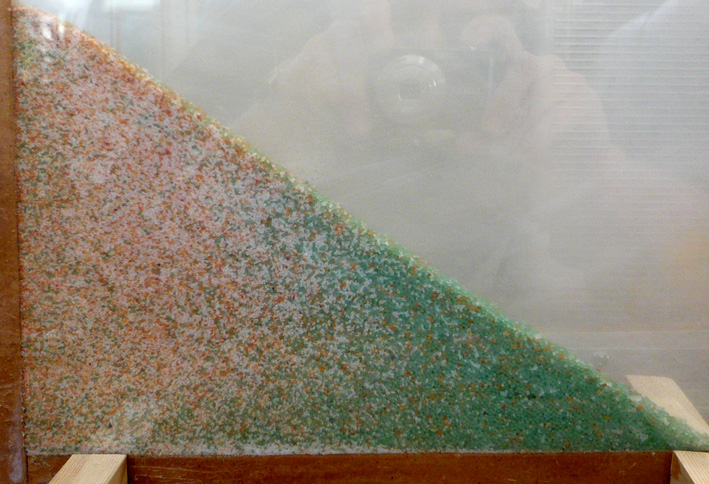
Some further observations, and hints for readers who wish to try this at home (or in the classroom).
I was, as you could probably tell, flushed with the success of making cross-bedding in the comfort of my own kitchen, and eagerly awaiting the arrival of colourful granular materials from the aquarium supplies place. I had, much to my wife’s appreciation (and, indeed, mine, since, much as I like sand, grains in your dinner are a step too far), removed my lab from the kitchen. The substantial box of supplies was delivered and I set up to enthusiastically scatter granular materials around a different room in our apartment. Not being familiar with aquarium interior design and therefore not knowing quite what to expect, I had ordered quite a variety of materials, both in terms of colour and grain character; furthermore, I had happened upon a “buy one, get one free” offer and so was surrounded by a rainbow of pots of grits. The variety and volume available turned out to be a good thing.
Given that a simple mixture of sugar and play sand had immediately produced such dramatic results, I had blithely assumed that, with a little thought as to mixtures of grain size and angularity (with appropriately different angles of repose), I would easily generate even more dramatic structures, the colour variations picking out in fine detail the segregation and stratification in a visually satisfying way. But this was not to be. Given even my qualitative understanding of the unpredictability and fickleness of granular materials, I should have anticipated that it would not be that simple to induce them to cooperate. My first couple of mixtures essentially produced no internal structure at all, and then I succeeded in producing segregation, but not stratification. By this I mean that different families of grains would spontaneously separate, with smaller grains at the top of the pile, larger ones towards the base, as in the image at the top of this post; this was an interesting demonstration but hardly what I was looking for.
I then had a brilliant idea: I would actually re-read the original paper by Makse and his colleagues (available here); this proved - surprise, surprise - to be be extremely informative. To begin with, they used a combination of two grain types, initially white glass beads (repose angle 26 degrees) and sugar crystals (roughly cubic and with an angle of repose of 39 degrees); this produced spontaneous segregation and stratification. They then used a mixture of fine and coarse sand and achieved the same result (indicating that grain density was not a critical factor). They wrote:
In all the above experiments we used mixtures composed of two types of grain with different shape, and therefore with different angles of repose. In particular we obtain stratification (plus segregation) when we use larger cubic grains and smaller spherical grains: the angle of repose of the large species is then larger than the angle of repose of the small species. Otherwise we obtain only segregation and not stratification when the large grains are less faceted than the small grains, i.e., the large grains have smaller angle of repose than the small grains.
They continued with further experimental variables and concluded:
These results suggest that the phenomenon of segregation is always expected when pouring a granular mixture of grains of different sizes, no matter the values of the angles of repose of the species. However, the phenomenon of stratification is only expected when the large species have larger angle of repose than the small species. Additionally, we performed a series of experiments in which we find similar stratification by using different mixtures of differing size ratio between large and small grains (1.66, 2.1, 2.25, 3.25, and 6.66), suggesting that the phenomenon occurs for a broad regime of grain size ratios. We find a similar stratification when we double the gap between the vertical plates of the cell and simultaneously double the flow rate of grains.
They then moved on to mixtures of three grain types (a close-up of this stratification is shown at right): 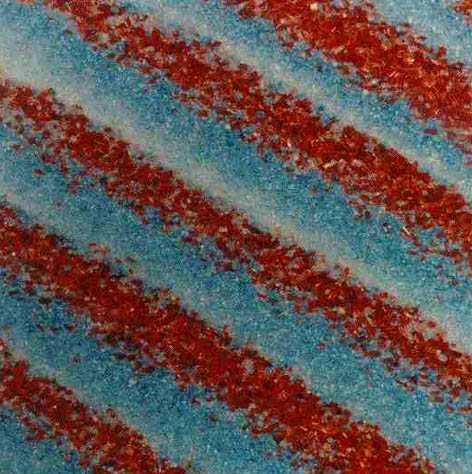
The experiment results in stratification with three layers, with the finest grains on the bottommost of each triplet of layers and the coarsest grains on the topmost layer … Experiments using a continuum size distribution are ongoing, since geological rock formations (which also display stratification) generally occur in the presence of a continuum distribution of grain size.
I was relieved that density was not a major factor (since, until I have a look with a microscope, I have no idea exactly what my aquarium decor is made of); I also followed their advice of cleaning the perspex with an anti-static cleaner - electrostatic effects between the grains can be important (indeed, it would seem to be influential in natural movement of sand by saltation, a phenomenon known as triboelectrification - perhaps more on that another time). I then repaired to, yes, the kitchen, and, on a series of plates, poured out a selection of my materials into heaps to determine grain size versus angle of repose. Selecting a coarse, black, angular, material (strictly more of a gravel than sand) with a steep angle of repose and fine, golden, semi-rounded grains (gloriously titled “imperial yellow”) that formed a distinctly more gently sloping pile. I mixed up these materials, fully expecting to produce a sort of dramatic bumblebee effect - but they refused to cooperate, segregating somewhat but not really stratifying. As a result of this and my previous experiments, I was now surrounded by pots, tupperware etc., stolen from the kitchen and containing a wide variety of colourful, but non-performing mixtures. I added some fine, almost spherical “diamonique green” and tried again: hints of stratification. Becoming more desperate and, as if it were possible, less analytical, and having great faith in natural sand, I then mixed in a large proportion of the play sand (still, I believe, with some sugar) and poured. The result was dramatic and not unlike the illustrations in Makse’s paper:
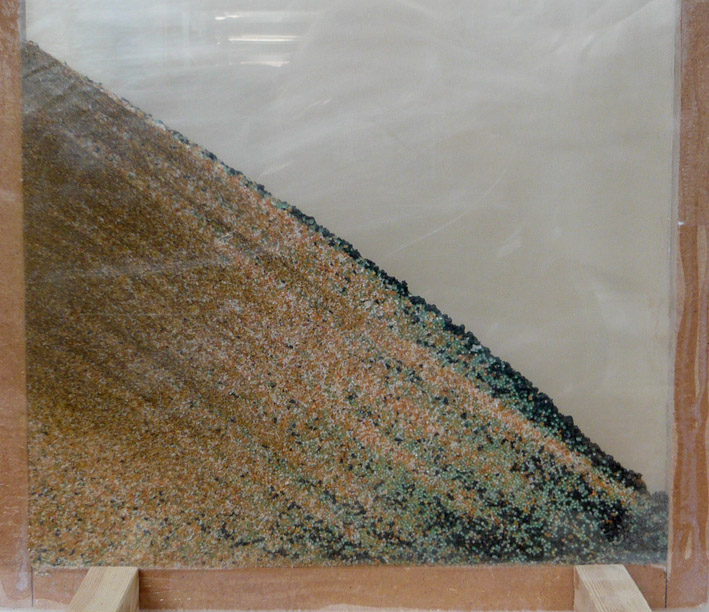
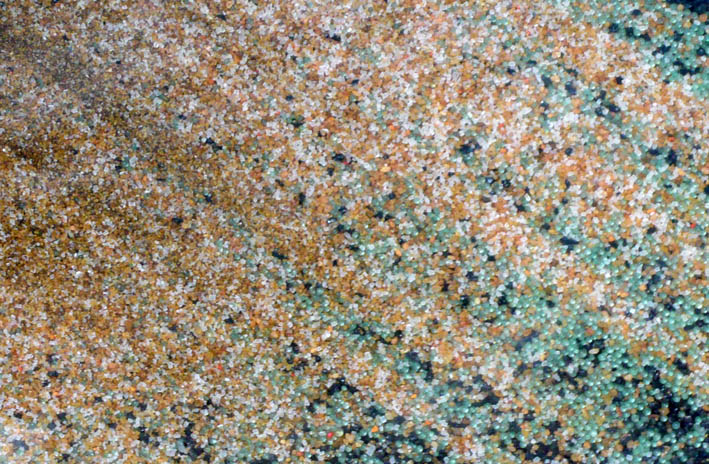
Both segregation and stratification appeared, and each stratified layer was clearly beginning to show sorting by grain size:
So, what is it about natural sand that seems to make it self-stratify more spontaneously than the artificial materials? Clearly, my “kitchen physics” is not conducted under strict laboratory conditions, I have not quantitatively evaluated the grain size, sorting, and shapes of my materials, and I have not rigorously recorded the many permutations and combinations now occupying the small army of tupperware containers on the floor; I am, in short, overwhelmed by my variables. But here are my amateur conclusions:
- Using an anti-static cleaner is probably important.
- Artificially coloured materials are valuable in offering a range of grain types and in highlighting internal structure of the pile.
- Natural sand is probably a key ingredient in most easily producing stratification.
- Adding sugar is, pragmatically, likely to produce results.
- Varying the rate of pouring produces different outcomes.
I shall continue (it is, after all, an excuse to play), but if anyone has recommendations and further experiences to contribute, I would be delighted to hear them.
Comments
No comments yet.