Dear Michael,
In the past week, I’ve been the fortunate recipient of six new samples for my sand collection! From Florida and Alaska, they are welcome additions to my collection. It now spans both poles and every continent save Australia. (Australia, anyone?…)
I’ve always enjoyed just looking at my samples and reflecting on their origins, but as I have told you, reading Sand has made the collection so much more meaningful and interesting. And as I have come to realize how ubiquitous and unappreciated sand really is, barely a day has passed that I haven’t observed some satisfying psammophilic signals in my surroundings! Thank you, again, for sharing your knowledge.
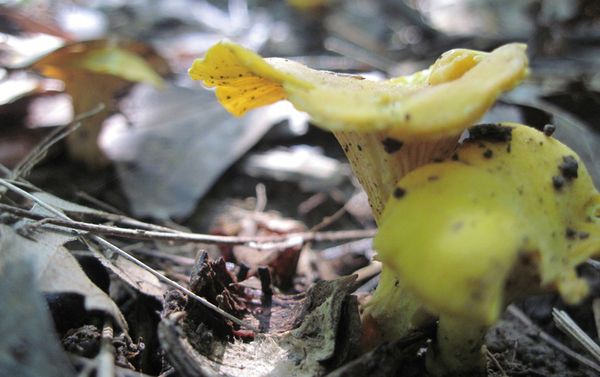
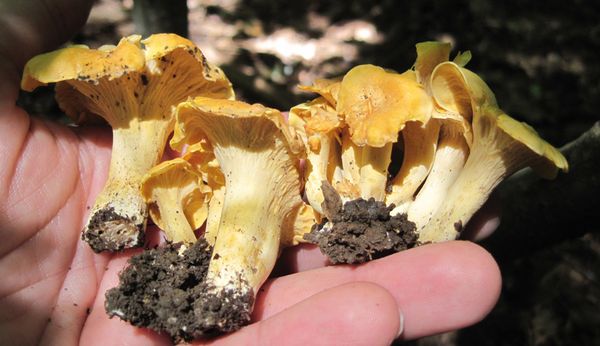
According to my calendar, our first conversation roughly coincided with the emergence of a rather spectacular “bloom” of the eastern smooth chanterelle mushroom (Cantharellus lateritius) in the woods behind my home. Rivalling its more famous cousin, the yellow chant (C. ciborium, a.k.a. the pfifferling or girolle), this mushroom is beautiful and tasty. It temporarily became the focus of my spare time, and I would walk the dog or take my children into the woods for some quality mushroom gathering before the season slowly ended two weeks later.
We happen to live on a hill in Northeastern Ohio. It’s a little college town, surrounded by pastures, Amish communities, and forest. Most of the land on “The Hill” was burned and clear-cut in the early 19th century for farmland, and eventually became the home of a theological seminary that evolved into a modern-day college. Somehow, a few small tracts of forest remained untouched and to this day represent some of the largest stands of virgin beech-maple forest in the state of Ohio.
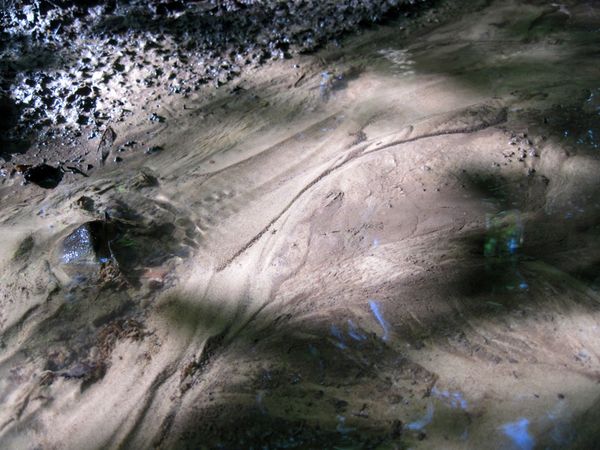
In the recent geologic past, about 10K years ago, the hill was deposited by an enormous melting glacier. This glacier had scoured soil and rocks from the land below. Like a bulldozer, the ice pushed and lifted clay, sand, gravel and larger objects and dragged them southward as it advanced. In that load were millions of tons of rock from a series of earlier glaciers, themselves slowly gouging eastern Lake Erie from the shale and sandstone depression left over from the age of the dinosaurs. Eventually, the glacier melted, dumping piles of sand and rock material called “kames” and scooping out holes forming hundreds of “kettles” or small lakes which dot the area to this day. The streams running through the woods behind my house still bear sand that has only recently been freed from the sandstone boulders that form the hill. They will eventually enter the Ohio River in Pittsburgh before heading to the Gulf of Mexico to be compressed back to stone.
In between the glaciers and the clear-cutting, native Americans hunted deer, bear and turkey here. They gathered the available crop of raspberries and blackberries that are abundant. I like to think that they also enjoyed harvesting morels, oyster mushrooms, chanterelles and other fine edible mushrooms that still grow wild in the remaining forest.
The mushrooms grow here because they require unbelievably specialized habitats. Many are so specific that there is still no way to produce them commercially, and so the only way to enjoy them is to get out in the woods and harvest them personally. No one really knows, for example, what triggers each of the three (or so) species of morel to emerge – what combination of nutrients, soils, moisture, etc. is required every spring to make them pop up, and eventually into, the mouths of their eager fans. So too, is the smooth chanterelle. We have observed it in isolated patches throughout the beech-maple forest behind my house. But mostly, it prefers oak. And mostly, it prefers paths!
As I mentioned, the forest here is dominated by beech and maple trees. However, species such as cottonwood and oak will occur if the soil conditions are right. Oak trees, and especially our local pin oak, Quercus palustris, live in habitats that are moist and comprised of clays and sands. As they grow, the roots form a network of tiny organic storage containers that the chanterelle can apparently tap without harming the tree, and perhaps even provide some unknown benefit in return. This is called a mycorrhizal relationship. So, the chanterelle, which is associated with the oak trees here, depends upon the sand and clay soil. But why paths? The best explanation I have read suggests that soil compaction plays a role. Where deer paths or human paths cross the sandy forest floor, the grains become more tightly packed near the surface where the mycelium of the fungus lives. So it bunches up at this interface between loosely packed and hard packed grains until environmental cues (temperature, moisture, and metabolic state) cause the fungus to fruit!
So, to tie this all together – I’ve been enjoying the wonderful delicacy of chanterelle mushrooms collected from paths running below oak trees that are growing in sand and clay deposited by the retreat of a glacier thousands of years ago. Without that glacier, there would be no sand, no oak, no chanterelles!
I’ve attached a few pictures to jazz up my rambling. Thanks once again for transforming the seemingly mundane world of sand into something fascinating.
Rob Robertson
Hiram, Ohio
[I first heard from Rob about a month ago, another of those hugely pleasurable “out of the blue” e-mails that put me in touch with one of the readers of this blog. We shared thoughts and questions on Martian water and landforms, and, always seeking alternative voices, I asked Rob if he would like to write a guest post. I was delighted by his positive response and so here it is; modesty insisted that I contemplate how to deal with his complimentary comments, but it reads as it is, a personal letter, and much appreciated. So modesty was swallowed. And the discovery of the word the word “pfifferling” is to be treasured in its own right - I feel an omelette coming on.]
Comments
Nice piece! Pfifferling; Love it.
And I love the range of scales, in time and space. Never before have I seen the limen between tight and loose soil proposed as an ecotone, but it makes perfect sense. Also, this is beautifully written. It reminds me of a very pleasant summer mostly spent at Findley State Park, the other side of Cleveland. Thanks for the memories, Rob.
Thank you, Richard!
You may already know this, but Findley S.P. is situated in the “ridges” of north western and north central Ohio, and those ridges are the terminal moraines of the same series of glaciers that I refer to. I’m hoping there is sand in “them thar hills,” as my family will soon be relocating to a town in that region. If there’s sand, then maybe chanterelles or other oak-loving edibles like the sulfur shelf.
http://ohiodnr.com/portals/10/pdf/sem_tone.pdf
-Rob
Good luck with the fungi, Rob, and with the relocation. And thanks for the map; it’s pleasant to visualize the glaciers lapping up against the Appalachians, a great slow ocean.