In the film blog of the British newspaper, The Guardian, a few days ago, the weekly feature called “Clip joint” called on readers to submit movie scenes featuring the desert, to compile “a tour of the best web morsels on Sahara-like expanses.” The writer declared that “I can’t find the exact quote, but somebody once said of Lawrence of Arabia something like, ‘The desert is the screen.’ Frankly, with films, that’s all I need to hear. Help me to my seat forthwith, usher: I need an extra-large tub of grandeur, and sand in my hair.” (For non-UK readers, the “usher” refers to the person in a cinema or theatre who shows you to your seat, and the “tub” is is a - traditionally mediocre, but you do find Baskin Robbins these days - container of ice cream). Now geologists obviously have a unique and idiosyncratic perspective on this; I have spent long periods in movie theatres losing the plot but trying to figure out from the background geology where a scene was actually filmed. And, of course, I’m particularly interested in films which don’t simply occur in a desert setting, but which the desert - and, ideally, the sand - is a critical part of the plot, if not an actual character.
So I’ve just spent a very enjoyable couple of hours looking through the responses in The Guardian, and checking out many of the YouTube links (I’d already added my own, which I shall come to shortly). The nominations cover a spectrum, from films in which deserts show up, through films which are largely set in an arid place, finally to films in which the desert and the sand are not just the background but a constant theme - they have roles, they provide tension. In the first category of the spectrum, one can move from Casino, Ben Hur, through Paris Texas and There Will be Blood, to Zabriskie Point which starts the next category. Ice Cold in Alex, The Good, the Bad and the Ugly (Clint Eastwood’s forced walk through the dunes includes some great granular bits), The Flight of the Phoenix (both versions, the older one the better), Humphrey Bogart in Sahara (see my “angle of repose” post), and, of course, Lawrence of Arabia. Next, there is an obvious group which initiates the final category in the spectrum - Dune, Star Wars (the sand people and the deserts of Tatooine), The Sheltering Sky, and The English Patient (the initial scene of which, with the plane flying over the sunset-illuminated dunes, is staggeringly beautiful - I might, carried somewhat away, argue that dunes are female…).
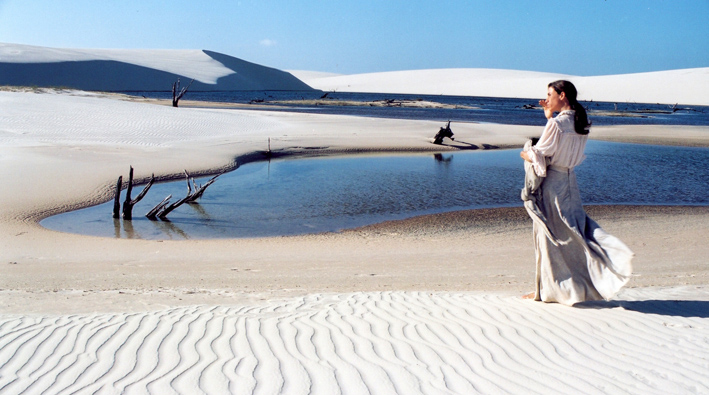
Which brings us to the extreme sand end of the spectrum. Runner-up is The House of Sand, from which the image at the head of this post is taken. Set in the spectacular landscapes of Brazilian coastal dunes, this 2006 film by Andrucha Waddington won that year’s Alfred P. Sloan prize at the Sundance Festival - well-deserved, in my view. The story follows three generations of women (two played by the extraordinary Fernanda Torres and the other by her real-life mother) stranded in the dunes as a result of male dementia. Against the backdrop of this spectacular landscape, and with the ever-shifting sands playing their role, the film follows threads of history: from the 1919 expedition to the dunes to use a solar eclipse to attempt to demonstrate the curvature of space, as predicted by Einstein, through WW II to the moon landings. When her mother asks what they found on the moon, the daughter replies “nothing but sand.” Scenery, science, history, drama, stunning cinematography, sex, and great acting, this movie has it all.
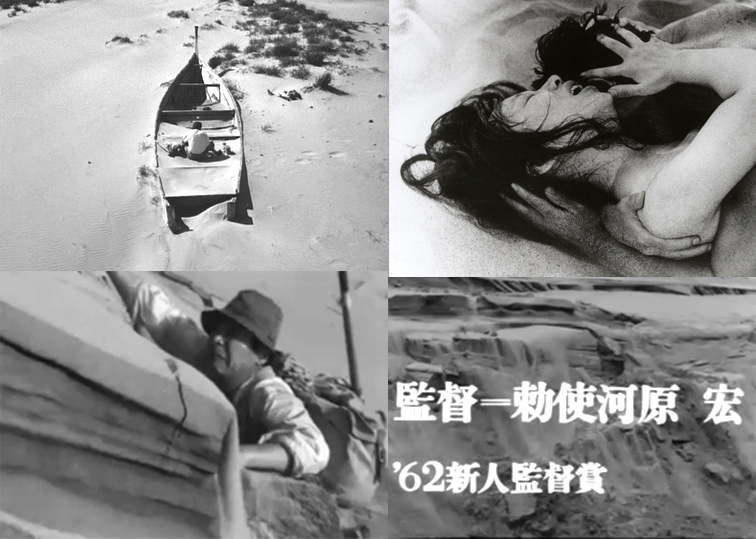
But the grand prize, in my personal “best arenaceous movies of all time” list goes to Woman of the Dunes, the 1964 film of Kobo Abe’s book The Woman in the Dunes. The slight difference in translation is confusing, but the book title more accurately reflects the story. Hiroshi Teshigahara’s film won the Special Jury Prize at the Cannes festival and was nominated for the Best Foreign Language Film at the Oscars. Filmed among Japan’s Tottori coastal dunes, this surreal movie features a lost entomologist who finds himself essentially kidnapped and marooned at the bottom of a deep hole in the dunes where a widow is kept by the bizarre local inhabitants to sweep the ever-encroaching sand from her house. If it sounds weird, it is - but it’s compelling. The characters - and the viewer - lose all sense of time, which becomes measured only by the movement of sand and the daily routine of their battle against it. There are constant and meticulously observed scenes of the behaviour of granular materials (hardly a common commendation for a film, but I thought they were brilliant). Sand really is a major character - and the concept of “sand and sex” takes on a whole new meaning. The film is wonderful, but the book is well-worth reading too - one quote:
Because winds and water currents flow over the land, the formation of sand is unavoidable. As long as the winds blew, the rivers flowed, and the seas stirred, sand would be born grain by grain from the earth, and like a living being it would creep everywhere. The sands never rested. Gently but surely they invaded and destroyed the surface of the earth… While he mused on the effects of the flowing sands, he was seized from time to time by hallucinations in which he himself began to move with the flow.
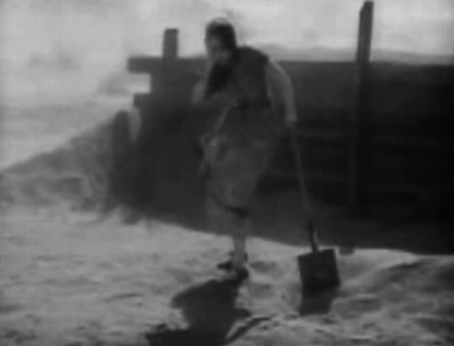
As an endnote, the theme of wind, sand, and madness is not a new one. Thanks to one of the comments in the Guardian blog, I came across scenes, evocative of Teshigahara, from the 1928 silent movie, The Wind, in which Lillian Gish (whom I have always thought extraordinary), is, in the end, saved from madness and driving sand. It was filmed, in part, in the Mojave Desert.
[to see the Guardian blog list in full, go to http://www.guardian.co.uk/film/filmblog/2009/apr/01/1; for a taste of The House of Sand, http://www.youtube.com/watch?v=BlxSR1-sErk; Woman of the Dunes, http://www.youtube.com/watch?v=K1mpRGqkpAs; The Wind, http://www.youtube.com/watch?v=I-Q2vDNyqXM&NR=1]
Comments
Wonderful post Michael.
I also love desert themed movies which feature the feeling of such challenging, remote,and expansive wilderness as backdrop for human drama and adventure. The beautiful,rich colors and late afternoon light captured by many of these movies is especially memorable. The very sensual desert scenes in the English Patient were gorgeous and helped by the haunting and evocative music score. Lawrence of Arabia and the original Flight of the Phoenix are also two of my all time favorites .
I researched some of the sketchy information available on location shots of Lawrence of Arabia and a important scene which stands out for me was the incredible charge on the port city of Aqaba,Jordon; which was actually a studio built location near Almeria, Spain,in a inland drainage basin called Playa del Algorocibo. I tried finding a match for this landscape with Google Earth near Almeria and I have not been able to see a valley open to the ocean that matched that memorable scene. I need to rent the Sheltering Sky and also have the soundtrack which I bought because I follow the works of the composer Ryuichi Sakamoto
Here is one reference to this location as a film construction and is near the bottom of that long web page.
http://www.magicalspain.com/calendar/topSights_frameset.htm
Here’s another film location area called Wadi Rum
http://en.wikipedia.org/wiki/Wadi_Rum#Filming_location
A “tub” of Baskin Robbins peanut butter and chocolate ice cream would be delicious anytime.! :)
Hi Jules - thanks for the comments and further references. I’ve been meaning to watch Lawrence of Arabia again, so will watch out for the Almeria scene; some of the movie was shot in Morocco but most of it was indeed in Spain. “Dune” was mainly filmed in Mexico, some of “The Return of the Jedi” in the Imperial Sand Dunes of Arizona, and “The English Patient”, although set in Egypt and Libya, was shot in Tunisia, including the reconstructed “Cave of the Swimmers.” Incidentally, I visited the original cave (and I’m not convinced they are swimmers) which is, incredibly since it’s hundreds of miles from anywhere, despoiled by graffiti.
It would be sort of fun to compile a “great geological movie locations” list!
Thanks Michael
I just finished Robert Twigger’s interesting biographical account “Lost Oasis, In Search OF Paradise”(was it you that recommended this book?) and he commented also that the “swimmers” had been marked with graffiti. I have read that not a lot of people on organized tours get out to the Gif Kebir, but evidently there are those who cannot resist leaving their egotistical marks on everthing they touch…no respect for much of anything including irreplaceable artifacts of our past.
I agree with you that the images I have seen in photos do not exactly look like swimmers, but there is evidence that the Sahara was once a wetter environment so I guess it’s possible.
http://www.newworldencyclopedia.org/entry/Sahara_Desert
http://www.touregypt.net/featurestories/gilfkebir1.htm
Twiggers book review: http://www.guardian.co.uk/books/2007/aug/05/travel.features
I noted that Twigger made reference to Bagnold as being a “speed freak” in that he liked to drive fast through the desert vs Twiggers desire to walk on foot and try to soak in what he was experiencing. From Twiggers book though he explained that driving through some of the deep sands requires that extra speed and skills to get through many areas.
From my ancedotal memories I think there would be quite a few movies that qualified as great geological movie locations including one I mentioned at the “Looking for Detachment” blog a while back; Mackeena’Gold with Gregory Peck(1969) which was filmed in some remarkable canyons of the US Southwest.
Not sure if it was me who recommended Twigger’s book, but I definitely mentioned it in mine - I spent a great few days in the Western Desert with Rob a couple of years ago. Yes, human egotism is amazing - several of the graffiti at the Cave of the Swimmers were such that the perpetrators could be identified - dominantly from one country which I will not name, but not the US or the UK! The trouble is that these places are not so remote that determined people can’t visit them, but they are remote enough that safeguarding them and preserving them is essentially impossible.
The Sahara was indeed much wetter not that long ago (in geological terms)and had giraffes and all sorts of other milder climate animals, plus, of course, the people who made the rock art. And there were undoubtedly lakes so yes, maybe they are swimmers. The thing that struck me was that all of the imagery there and at other sites in the region seems to be “spiritual,” perhaps shamanistic or whatever, rather than recording anything related to everyday life.
Rob’s right about Bagnold and speed - here’s a quote from Bagnold describing the first time he surmounted a dune in a vehicle (this time a truck rather than his Model T):
“I increased speed to forty miles an hour, feeling like a small boy on a horse about to take his first big fence. I saw Burridge holding on to the side of the lorry grimly. Suddenly the light doubled in strength as if more suns had been switched on. A huge glaring wall of yellow shot up high into the sky a a yard in front of us. The lorry tipped violently backwards—and we rose as in a lift, smoothly without vibration. We floated up and up on a yellow cloud. All the accustomed car movements had ceased; only the speedometer told us we were still moving fast. It was incredible. Instead of sticking deep in loose sand at the bottom as instinct and experience both foretold, we were now near the top a hundred feet above the ground. Then the skyline receded disclosing a smooth blank surface of some sort, nearly level. The glare was intense; one could distinguish nothing, but from the slow rolling movements of the lorry, we must be going over a series of gentle undulations.
I cut off the engine and let the car come to rest gently to wait for the others. The sand was covered with little ripples that had flown by too fast to be seen while the car was on the move. Our wheel tracks behind were barely half an inch deep; they trailed out behind cleanly like a pair of railway lines. Yet the sand was quite soft; I ran my fingers through it easily, and there was no surface crust to support the wheels. It was just the special way the grains were packed."
Even today, with highly capable 4 wheel drives, desert driving is a skill(and an art)that often requires high speed, even though consequences of a mistake can be dire!
I’ll have to check up on the Looking for Detachment blog - and the Gregory Peck movie. Anyone else out there like to add to the collection?
Re the location for the filming of the charge on Aqaba in Lawrence of Arabia. It’s actually quite a ways around the coast from the city of Almeria - the beach at El Algarrobico. Right now, the Google Earth share/post feature for a placemark tells me that it’s temporarily disabled, but if you find Carboneras on the Mediterranean coast northeast of Almeria, then there’s a wide, dry river valley a few kilometers north - the red-coloured bluffs on the northern side are distinctive, and there seems to have been a modern coastal road built since the filming.
I was inspired to watch the “Director’s cut” version of Lawrence yesterday, together with the extras (“making of” etc.), and there’s some fascinating information. The “dry quicksand” scene (controversial in a granular materials sense since no such stuff has been recorded as swallowing anything) required extraordinary special effects. A large box was built and covered with a device like a camera diaphragm, built on the spot out of sheet rubber. The special effects guy then got into the box which was buried in the sand and he pulled to actor slowly down through the diaphragm into the box with him!
But what a movie - talk about standing the test of time.
Thanks again very much Michael for researching this further. I saw the photo from your email. I will go back to Google and look closer at this site.
Glad you were inspired to the the film again. I was elated in the late 80’s when the restoration of the movie was done for the film to preserve what is truly one of cinema’s masterworks. Years ago in a magazine devoted to film I saw images from the original film reels that had seriously deterioated and photos of what the restoration would do to revive the colors and detail.
Turner Classic Movies is also behind the efforts lately to restore and preserve old films that would have literally turned to dust in less than a century because of the stock they were filmed on. Not only do movies provide us entertainment,but in many ways they are a irreplacable window back into our past,customs and clothing styles.