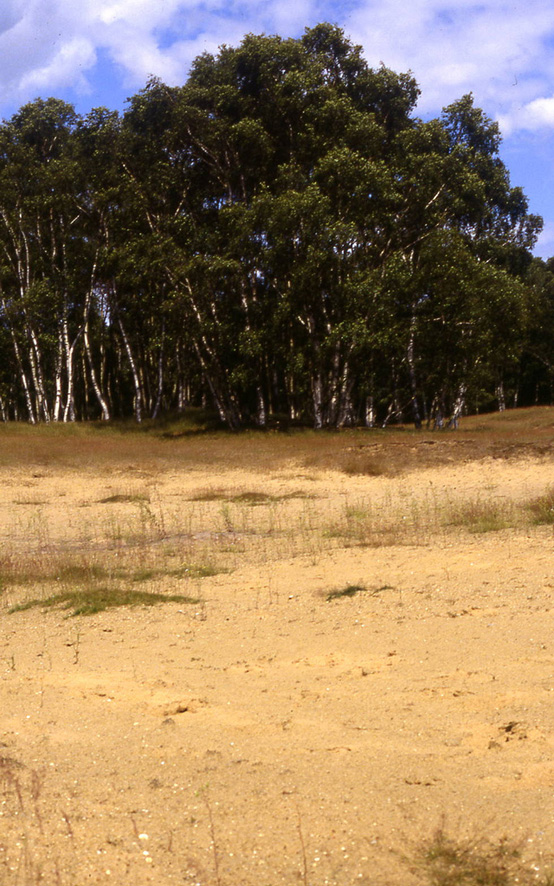
The little village of Santon Downham, on the border of Norfolk and Suffolk in East Anglia, is today a pleasant, if not particularly remarkable, example of bucolic English hamlets. But it has one extraordinary claim to fame: in the middle of the seventeenth century, over a period of several years, Santon Downham was almost overwhelmed and buried in sand - the great “sand-flood.” Dunes several meters high piled up against walls and houses, and sand choked the nearby river. Even a century later, a visitor’s account describes “….such a piece of absolute desert almost in the heart of England … Nothing was to be seen on either side but sand and scattered gravel without the least vegetation; a mere African desert.”
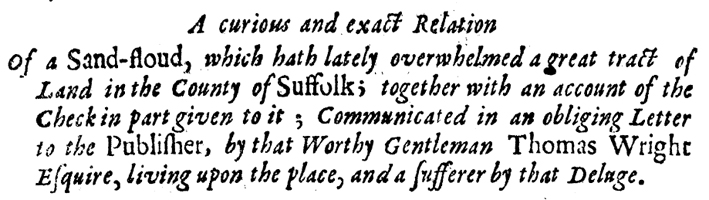
Sandstorms and migrating dunes in the English countryside? This whole area of East Anglia, a low-lying and very dry area of heath known as Breckland, or “the Brecks,” is covered in sand beneath the surface, sand that was derived from the geological rubbish left behind by the Ice Age glaciers and the meltwater rivers that poured across the bedrock chalk of the region. As climatic conditions - and man’s activities - changed, the sands would become active and accumulate into dune fields, marching across the Brecks. Periods of activity were interspersed with periods of stability, the sands covered by soil until they broke free once more. A first-hand account of the inundation of Santon Downham was written by a resident, Thomas Wright, who, in 1668, described in a letter to the Royal Society, published in its Philosophical Transactions, the encroachment of the sand and his struggles to preserve his house; he also suggested the origin of the sand and his ideas turn out to be quite accurate. For a very modest sum, the original letter can be downloaded from the Royal Society archives, and it makes for fascinating reading. Here’s the title (remember the old ufe of “f’s” for “s’s”):
The body of sand, the “wing’d enemy,” had been on the move for decades, grown to cover more than a thousand acres, and reached the outskirts of the village 30 or 40 years before Wright’s account. There it paused for ten years “without doing any considerable mischief” but then took off, and “over-ran 200 acres of very good corn” in less than a year. But then Wright wrote, “'Tis now got into the body of this little Town, where it hath buried and destroyed divers Tenements and other Houses, and has inforc’d us to preserve the remainder at a greater charge than they are worth.” Wright and the other villages struggled to fend off the dunes over a period of five years: “For, it had so possest all our Avenues, as there was no passage to us but over two Walls of 8 or 9 foot high (which encompass’d a small grove before my house, now almost buried in sand); nay, it was once so near a conquest, as at one end of my house it was possest of my Yard, and had blown up to the eves of most of my out-houses.” Wright resorted to planting “furre-hedges”, one of the earliest references to the use of conifers in Breckland. And then, month after month, he planted more on top of the newly-buried ones. He eventually ended up with “sandbanks nearly 20 yards high.” These, with the help of his neighbours, he covered with “some hundreds of loads of Muck and good earth,” and cut a passage through to his house. These early attempts at dune stabilisation seem to have been effective. Today, the geological map shows the entire area still covered in sand, and the remains of dunes are visible in some places, but otherwise there is no sign of the great “sand-floud.” Not that sand isn’t still on the move - in the spring vast piles of sand have to be cleared off roads after high winds, and there are places where cars sometimes need their lights on as they pass through sandstorms.
So where did this “eruption,” driven by “the rage of those Impetuous blasts,” actually come from? Wright suggests from the warrens of Lakenheath and Wangford, just a few kilometers southwest of Santon Downham; recent work by Steve Godby from Anglia Polytechnic University in Cambridge and Mark Bateman of the University of Sheffield suggests that he was, living up to his name, right. The warrens (and yes, rabbits do come into this) are areas of disturbed sand dunes, more or less overlain by scrubby vegetation and planted pine trees (see the photograph at the head of this post, courtesy of Martin Sandford), next to the American Air Force base at Lakenheath, where the construction of the golf course must have essentially been an exercise in isolating the bunkers (sand traps). As a personal aside, I was intrigued to discover this because, as a graduate student, typically struggling to make ends meet, I taught geology evening classes for the University of Maryland programs at various air bases, including Lakenheath - little did I realise that I was in the midst of a great landscape of sand or that I would be writing about it these many years later. But, back to the warrens. Godby and Bateman have established the chronology of the periods of activity and stability of the sands using luminescence on the sands and radiocarbon dating on some of the organic-rich peaty soil layers that formed during the quiet periods (luminescence dating is an extraordinarily powerful technique that measures how long it has been since material, for example sand, was last exposed to light - more on this in a later post, but see the excellent USGS discussion).
Five periods of sand deposition have been identified, 6500, 1600-1100, 500, 400-335, and 200-30 years before the present. The 400-335 dates, corresponding to the 17th century AD, come from Santon Downham - these ages are not found in the sands of Wangford Warren, and it’s reasonable to infer that this is because the sands were blown out of the Warren and inundated Santon Downham. And the event described by Thomas Wright was not the first - at least one previous sand deposition event has taken place at the village.
The exact combination of climatic and other circumstances that lead to each episode of sand activation are complex, but some factors around the sand flood event are clear, as described by Godby and Bateman. The period 300 to 600 years ago was drier than average, sea level was relatively low, and, from around 650 to perhaps 50 years ago, Europe was in the “Little Ice Age” - and the 17th century was the coldest in the last millennium. Changes in the North Atlantic circulation caused periods of highly variable conditions and extreme storminess. Vegetation on the sands of Breckland would have been stressed and the sand vulnerable to the “rage of those Impetuous blasts.” Furthermore, human agricultural excess had resulted in deforestation and impoverishment of what soils there were. And then there were the rabbits.
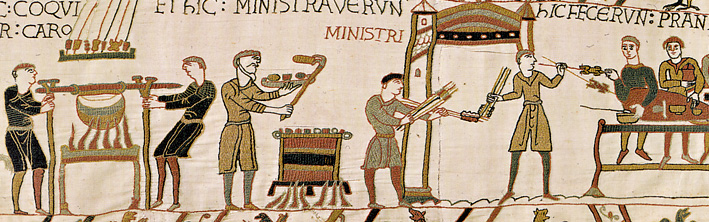
The Normans brought not only a whole new language to these islands, but a whole new cuisine. They introduced rabbits to the UK. The Bayeux Tapestry shows the invaders feasting upon arrival on these shores, and my personal interpretation is that the scene below depicts rabbit kebabs and spit-roasted rabbit.
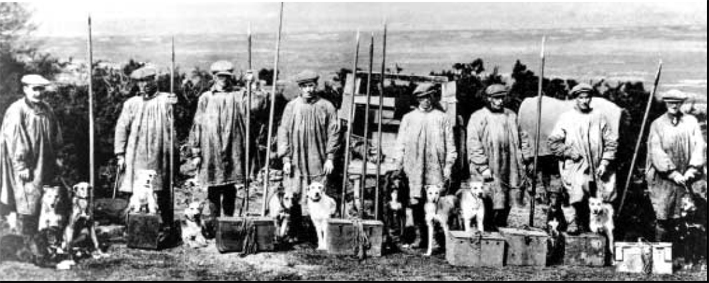
Rabbits breed proverbially, and while they were to some extent managed for food and fur, they took over vast swathes of the countryside. The sandy ground of the Brecks was ideal for them but they turned the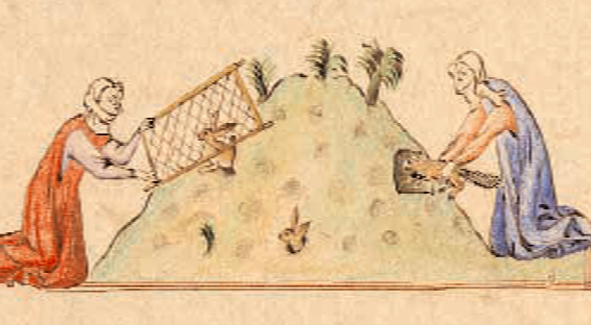 , all this activity generating significant income for the lords of the manor. The picture below shows warreners in around 1925, complete with lurchers and ferret boxes, and Lakenheath Warren in the background.
Without doubt, the rabbits contributed significantly to mobilisation of the sand dunes already activated by the changing climate and the inundation of Santon Downham. But all this was happening not just in England. The Brecklands and other inland sand landscapes of England lie at the western end of what is known as the “European sand belt” that extends across the lowlands through the Netherlands to the Polish-Russian border and beyond. Coastal dune systems are familiar to all of us, but these stretches of inland sand seas (well, perhaps “seas” is a slight exaggeration) are less well known, and are the subject of some fascinating work going on in the realm of geoconservation. This kind of research in the Netherlands was what originally prompted this whole story - but that will have to wait until Part 2.
{Thanks to Martin Sanford for the use of his photograph at the top, from his flickr photostream that includes several images of Wangford Warren. There is a comprehensive guide to the Brecks at http://brecks.org/default.aspx, and the image of warreners, originally from the Ancient House Museum in Thetford, is from one of their downloadable leaflets; http://www.brecks.org/shared/pdfs/brecksfa.pdf is an excellent environmental and historical resource for teachers. Short summaries of the sand flood and the recent research can be found at http://www.santondownham.org/sandflood.html and http://www.santondownham.org/moderntimes.html. My thanks to Richard Cathcart for starting me off on this - he sent me the paper on the Netherlands geoconservation project, which reminded me of the Santon Downham story that I originally intended to include in the book but which ended up as one of the items on the cutting room floor - back to Richard’s reference in Part 2.]
Comments
I did not know that rabbits were an introduced species in Britain. This post was great, and I like the reference (again) to the Bayeux Tapestry.