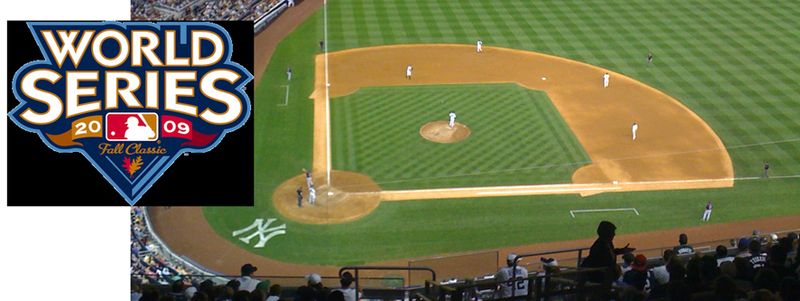
My daughter and her grandfather, both in Philadelphia, will probably, to put it mildly, have less than kind words for me when they see this post. For the Phillies (last year’s champions) were beaten in the baseball World Series last night by the New York Yankees - of all teams, it had to be the Yankees (for non-North American readers, I have appended some brief explanatory notes at the end of the post). Angst, tears, and rage in Philadelphia, exuberant celebration in New York. But, for Through the Sandglass, it’s just another opportunity, to point out the ubiquity of my topic - in the continuing tradition of my daughter’s Simpsons challenge.
For a start, like many sporting surfaces, the construction of a world-class baseball field relies on first-class sand. The iconic diamond, its grass and its surrounding “dirt,” are made from specialty materials. Go to the website of the Beam Clay company of Great Meadows, New Jersey (“Your ‘one-stop source’ for America’s baseball and sports turf surfaces and supplies!”) and you will be bewildered by the choice of over 200 products for the construction, care, and maintenance of your dream infield - for example, their “Premium infield mix”:
Made from uniform orange sand and red Beam Clay® with our special binding process that reduces wind and water erosion. Doesn’t separate and blow away! Doesn’t become dusty in stadiums! With proper maintenance, provides firm traction without tracking, good drainage while retaining playing moisture, distinctive reddish/orange color, works up readily, no separation of ingredients, long lasting, safe to slide on - for safe, attractive, consistent professional quality baseball diamonds.
The nature and performance of the materials used for the batter’s and catcher’s boxes are particularly important, but as in the action of a game, the pitcher’s mound has to be a focus of attention. A good history of the pitcher’s mound and how to construct one can be found here; the ingredients and recipes vary little - although the climatic environment of the stadium is important. This particular summary is from http://www.baseball-almanac.com/:
should have a significant concentration of clay to provide the necessary stability to resist degradation from increased traffic. A good material will be about 40% sand, 20% silt, and 40% clay. If necessary, you can mix individual components together. Just be sure that individual components are evenly distributed throughout the material.
A quality infield material will have a lower concentration of clay than the pitcher’s mound. The infield skin should be moist and firm, not hard and baked dry. To achieve firmness, an infield mix should not be too sandy. An infield mix with greater than 75% sand causes unstable footing for ballplayers and increases infield skin maintenance problems. A sandy infield will create low spots more quickly and is more likely to create lips at the infield skin/turf interface. Ideally, the infield mix should be between 50% and 75% sand and 25% to 50% clay and silt. A combination that has been successfully used is a 60% sand, 20% silt, 20% clay base mix (sandy clay loam to sandy loam). The silt and clay give the mix firmness. If the mix contains too much silt and clay, compaction and hardness become a problem.
So, a skilful (and well-paid) pitcher can stride out to his patch with confidence that its consistency will provide a reliable foundation for his art. And, in the case of Mariano Rivera (“Mo”), who finished off the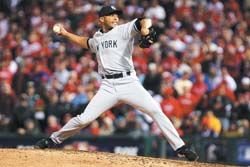 .
.
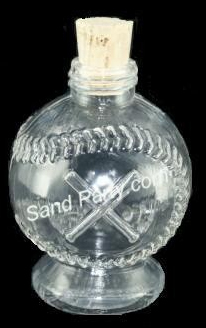
And then, of course, there’s sand lot baseball. And plastic baseball-shaped bottles that can be filled with coloured sand - but one example of a wide range of such things; I couldn’t possibly comment on their artistic merit - but I suspect that Andrew Clemens will not be rolling in his grave…
Notes for non-American readers:
-
The “World Series” has been widely derided by non-North Americans as being no such thing, since no countries other than the USA and Canada can compete for it. In order to combat such accusations of sporting arrogance, it has often been declared that the name originates from the original sponsorship of the championship by the newspaper, The New York World, early in the last century. Indeed, my (American) wife firmly corrected me to this effect a long time ago. But it’s a myth - the “World Series” is, and always has been, exactly that (see Snopes). Not that I would in any way revert to my earlier derisive remarks … Always remember that the other life of Steve Gould, the extraordinary and revered evolutionary biologist and writer, was as a devoted and passionate baseball fan - of the Yankees.
-
I would no more attempt to explain baseball to non-Americans than I would cricket to baseball fans (both are challenges equivalent, in Shakespeare’s words, to “numbering the sands and drinking the oceans dry.”) Suffice it to say that both games are very much like the classic description of a soldier’s life - long periods of boredom interrupted by brief moments of terror (well, generally not exactly terror, but action, something to actually engage the senses and the emotions).
-
In the later stages of a game, the starting pitcher is often replaced by a specialist finisher - a “closer” like Mariano Rivera.
-
A baseball signed by Mo and with the words “Enter Sandman” can be purchased from http://www.mlbfansite.com/ for a mere $399.99 (knocked down, so to speak, from the original price of $501.86).
-
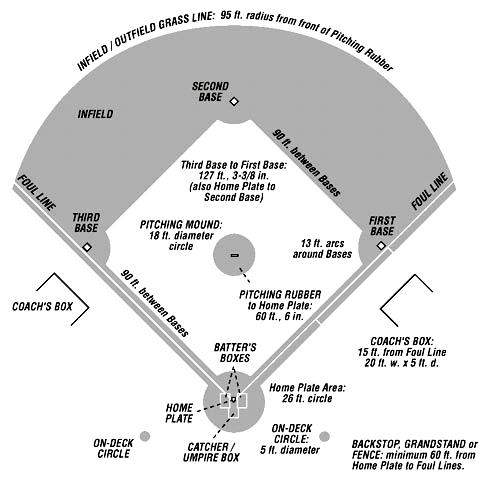
Herewith, from http://www.baseball-almanac.com/stadium/baseball_field_construction.shtml, a simple illustration of the layout of the diamond and the infield. From now on, you’re on your own.
Comments
that was good. you could do a series on various sports fields and importantly for Indian readers “the cricket pitch” :)
I like baseball world series its so very nice game and I like it.
Did you mean Stephen Gould, or not?
Yes, I indeed meant Stephen Jay Gould - see, for example, the article “Steve Gould’s Baseball Blind Spot” at http://harvardmagazine.com/2003/03/steve-goulds-baseball-bl.html and the collection of his writing on baseball, “Triumph and Tragedy in Mudville: A Lifelong Passion for Baseball,”