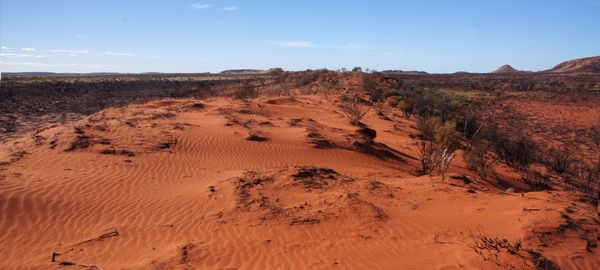
Georgia Bore is the place along the Canning Stock Route where we spent more time than planned - thanks to the mechanical failure of our primary four-wheel-drive vehicle. But there are far worse places to be stranded, not only in terms of being able to arrange being de-stranded, but it’s also in the midst of spectacular landscapes - including those of the long, seemingly endless, dunes that striate the western deserts of Australia. And the “Bore” refers to the drilled well at the location, a piece of good fortune, since we were never short of water during our sojourn there.The name “Georgia” originates from a tradition in the company that drilled the well that each of their camps should be named after the most recently born child of individuals working on the project: Georgia was the daughter of the senior geologist.
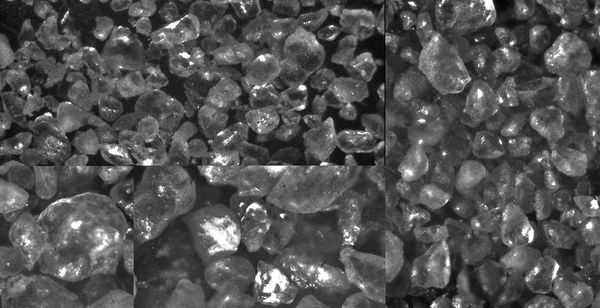
Having a little time on my hands to explore, I wandered, predictably, around the dunes. Like seemingly everything in Australia, they’re different. Not only kilometres long, not only vegetated, but the sand itself is not exactly typical of a standard desert dune. If you look at the grains of an Egyptian dune, they bear all the classic hallmarks of long periods of aeolian work: smoothed and rounded, frosted by the impacts with their brethren, and all much of a muchness in terms of size. But most of these antipodian grains, while clearly showing signs of having been knocked around, are still quite angular, and the variation in grain size is considerable. Does this suggest that their story is a fast and furious one, relatively brief but hyper-active periods of extreme aridity, punctuated by long periods of stability? I’m not sure - any suggestions?
Comments
Georgia is a great name for a geologist’s daughter. Would the vegetation reduce the average mobility of the sand? Or do cause and effect work the other way round?
I was beginning an unrefined search for some climate info on the area, and found some pictures of the Bore along with a custom interactive map and the local weather.
http://www.exploroz.com/Places/38/WA/CSR_Georgia_Bore.aspx
Maybe the sand is constantly weathered from laterite?
But no one wants to talk about wind. Here http://www.anra.gov.au/topics/rangelands/overview/wa/ibra-gd.html#climate there are some interesting bits, but the site is not updated and has broken URLs to another gov site where an economic bent prevails and finding data is not a promising prospect. (Correction: A bunch of 404’d links to other gov sites.) It’s just like looking for something like specific LandSat imagery from the US gov. :D
Uh, so did you think it was windy? The windspeed is 4 kph at the moment, but you had a longitudinal sampling of greater duration. ;)
I think I get better results from “Gibson+Desert”+paleoclimate and “Gibson+Desert”+aeolian+processes. Let’s see how much of it is behind paywalls, shall we?
Ha ha! From Wikipedia:
Paleoclimate
This section requires expansion. (July 2012)
See also
Hey, somebody just realized it should be there. That’s good.
Hi R and F - thanks for the comments and the ideas - and the research. I suspect that the relationship between vegetation growth and sand mobility is a complex one, a variety of the chicken and egg thing. Vegetation certainly reduces mobility, but the opposite is also true - mobile sand prevents vegetation gaining a hold. My guess is that the initial vegetation got going during a time of climate and aridity change, with perhaps sufficient rainfall during the transition to stabilise the sand and allow seeds to get a grip. If this has been a cyclical phenomenon from more to less to more arid, then the totally unvegetated periods when the sand was on the move may have been relatively short, and the grains did not have time to become appreciably rounded (it’s a slow process).
I can get pretty windy out there today - there were a couple of occasions on my trip that watched grains on the move, and I can verify that saltation is a global phenomenon. But I would also suggest that the total distance any individual grain travels is short, before it gets buried in a sand drift against a bush. And distance travelled is an important factor in grain rounding.