Today marks the end of this year’s Earth Science Week. In the past, I have summarised and discussed the “Big Ideas” that have been put together by the Earth Science Literacy Initiative; these are excellent, fundamental, and of global relevance, so I will highlight them again. Furthermore, they are now supported by a series of award-winning videos, directly downloadable as WMV files, and available on YouTube, so here are the direct links:
VIDEOS (WITHIN YOUTUBE):
Big Idea 2. Earth is 4.6 billion years old.
Big Idea 3. Earth is a complex system of interacting rock, water, air, and life.
Big Idea 4. Earth is continuously changing.
Big Idea 5. Earth is the water planet.
Big Idea 6. Life evolves on a dynamic Earth and continuously modifies Earth.
Big Idea 7. Humans depend on Earth for resources.
You will notice that each of the videos shows the number of times it has been accessed – I’m not sure how accurate these numbers are, but they are depressing. It’s not that I would expect such videos to go viral, but, for example, “Earth continually changes” has been viewed only a thousand times in less than a year. The entire Earth Science Week and Literacy Initiative sites provide an extraordinary wealth of superbly prepared and accessible resources and materials, but I have to wonder if there aren’t innovative ways of broadcasting this value more widely.
Here’s an extract from this month’s Earth Science Week Update:
AGI now offers award-winning videos and other electronic resources to help students, educators, and others explore the “big ideas” of Earth science during Earth Science Week 2012 (October 14-20) and all year long. AGI’s Big Ideas videos recently won three prestigious awards: Digital Video (DV) Winner in Education, DV Winner in Nature/Wildlife, and Videographer Award of Excellence.
Big Ideas videos are brief video clips that bring to life the big ideas of Earth science - the nine core concepts that everyone should know. The Earth Science Literacy Initiative, funded by the National Science Foundation, has codified these underlying understandings of Earth science which form the basis of the Big Ideas videos.
View the Big Ideas videos on YouTube (http://www.youtube.com/AGIeducation) or TeacherTube (http://teachertube.com/view_channel.php?user=AGIEducation). The Earth Science Week web site provides related resources. Educators can find dozens of classroom activities to help students build understanding of the “big ideas” online (http://www.earthsciweek.org/forteachers/bigideas/main.html).
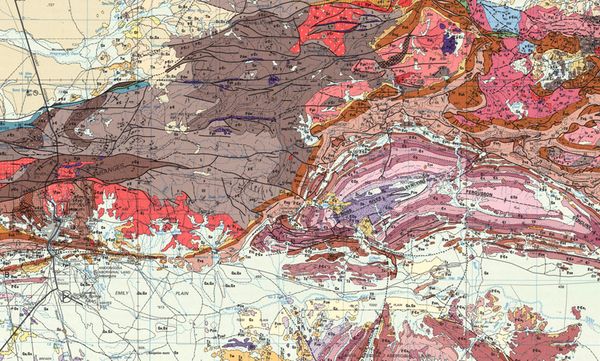
Oh, and since yesterday – a fact perhaps not widely known - was Geologic Map Day, here’s my celebratory contribution. Courtesy of the wonderful Geoscience Portal via which the Australian Government links geoscience data for the entire country, it’s part of the geologic map around Alice Springs, scene of my travels earlier this year. For me, it’s not only an illustration of the beauty of a geologic map, but it reverberates with ancient and complex geological stories – and the amount of human effort, thinking, and ingenuity it took to tell them, exactly what Earth Science Week is designed to celebrate.
Comments
Great map, thanks. It resembles stained tissue slices: patterns of growth by interpenetration, concentration gradients? Biomedical science has no problem holding public interest, but the explorers who gathered field observations into geology’s Big Ideas don’t offer stories of miracle cures or forensic solutions suitable for TV drama. Simon Winchester did try, with William Smith. Good for the organizers of Geological Map Day. You may enjoy this headline:
http://mtstandard.com/entertainment/tgif/hug-a-geologist-it-s-geologic-map-day/article_bd2d4d36-19c6-11e2-bad8-001a4bcf887a.html
A problem with visibility is that schools don’t teach much earth science. One would like to see teachers showing these videos in classrooms.
I just put some PR out on my personal Facebook site praising the video series. I have only seen the first video, but recognize that it is very well done.
There is so much informational overload, so much social networking fill of most extra time, that science of nearly any type becomes a niche. For a moment, if something gets the major attention of people, some focus will change to the physical world, for a little while… I also think there is a growing distrust, or fear being cultivated, at least in the US, starting with specific areas of science-evolution and climatology, for example of which is being extrapolated to other areas.