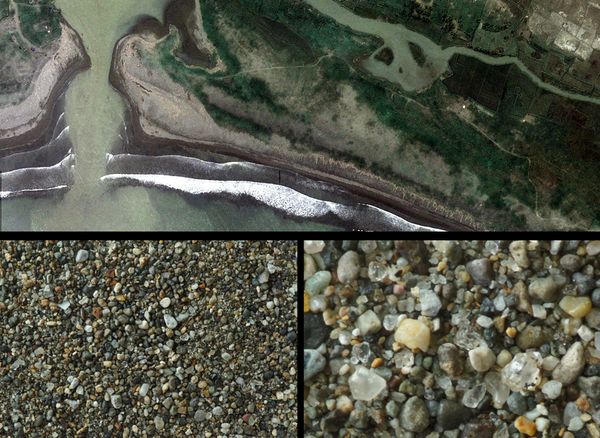
Pelabuhan Ratu, a sweeping beach on the south coast of Java pounded continuously by the breakers of the Indian Ocean. A popular destination, but one that I have not visited – today’s feature comes courtesy of, and with thanks to, Carol Banks, the latest recruit to my growing army of sand-snatchers.
Pelabuhan Ratu means “Queen’s harbour,” and the place comes with myths and legends galore – but more of that later: for now, the sand. The most popular and developed part of the long beach is a typical tropical white, but great stretches are also gloomily black and less attractive – except to an arenophile, for this is a lovely sand.
I chose the Google Earth image above to show the less-developed section, the river clearly bringing its cargo of black sands down to the coast. When the sand is wet, it is truly a dark charcoal-grey colour, but dry it out and it takes on a speckled brown and grey character – not particularly attractive at first glance. But look closely, and you will see transparent quartz grains, glittering like diamonds amongst the dull fragments of dark volcanic rock. Then there are the grains of the local limestones, together with a few shell fragments, shattered by the surf.
Looking more closely, those grains of transparent volcanic quartz really are beautiful:
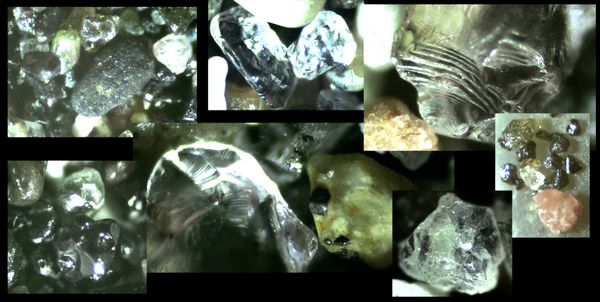
A number of them, dramatically the one at the upper right, show conchoidal fractures. These are where a material breaks along curved surfaces, often complex and rippled, very much the form of a mussel shell, hence the name (from the Greek for mussel or cockle). This behaviour is typical of amorphous materials such as glass and its natural volcanic version, obsidian – it’s this kind of fracturing that is exploited in the making of obsidian and flint tools. Strictly amorphous materials such as glass have no internal structure to guide fractures; this is not true of quartz, but its mineral structure, and the strength of the bonds between the silicon and oxygen atoms, make it behave very much as if it were amorphous.
The apple-green jewels amongst the grains are the mineral olivine, a common constituent of the kinds of volcanic materials of which Java is constructed. Shine the microscope light through the sand, and the glowing glory of these grains is revealed:
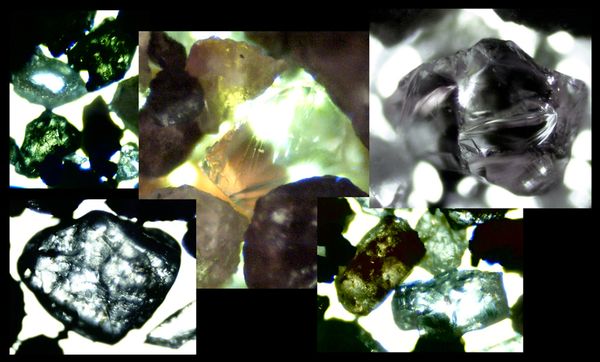
But, in the first group of microscope photos above, there are also very distinctive tiny black grains, clustering together, looking vaguely metallic, and often of a very regular, geometric, shape. What are they? Well, the answer is easily discovered by passing a magnet over the surface of the sand – these little grains defy gravity and hurl themselves upwards on to the magnet’s surface, reasonable behaviour for magnetite.
Magnetite is an iron oxide, chemical formula Fe3O4, and is another common constituent of the local volcanic rocks; it’s the most magnetic of all minerals, 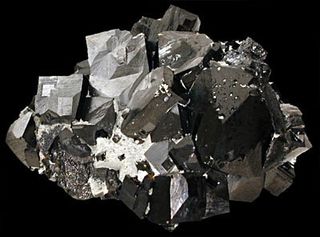 , and, along the south coast of Java these have been the source of sometimes violent conflicts between developers and local farming communities. But back to the bright side of magnetite, so to speak.
Because these grains do form placer deposits, a little amateur panning in the kitchen separated them out from the lighter grains (I could, of course, have used my magnet, but that wouldn’t have been so much fun). Here are some family portraits:
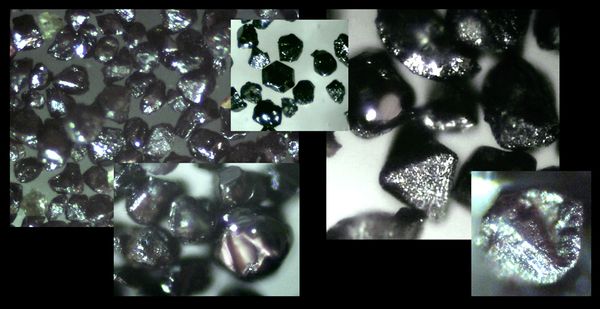
The amazing thing is that so many of these grains are hardly worn at all, and their original crystal shape is preserved. Look at the one that seems like two pyramids stuck together – that’s the original octohedral form of the mineral, a single, almost perfect, crystal of magnetite. Raw diamonds are often octohedral, but these grains are just humble iron oxide – beautiful nevertheless, don’t you think?
So, what about the queen whose harbour, or bay, is Pelabuhan Ratu? Well, this stretch of the Java coast is the haunt of Nyai Roro Kidul, the mythical Queen of the Indian Ocean in these parts, and a shape-shifting spirit of Javanese and 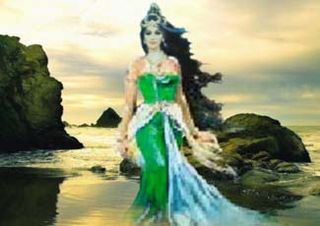 Sundanese folklore. She is, of course, beautiful, but she is powerful, able to take your soul on a whim. Various versions of the legend describe how a beautiful princess was struck with black magic by a jealous rival in the palace and developed a horrible skin disease. She fled to the ocean and plunged into the waves, where she was cured and crowned queen by the marine spirits and demons. Her sacred colour is green, and there is a local belief that wearing green will anger Nyai Roro Kidul – so, arenophiles, should you visit Pelabuhan Ratu, please choose your outfit with this in mind.
Comments
Wonderful pictures! The magnetite pics are particularly interesting, though I’m a big fan of olivine. Given the composition of the sand, shouldn’t the goddess’ dress be olivine green?
If you’re on Facebook, look up http://www.facebook.com/karen.locke.984. I’ve got three microphotographs (well, four if you count my avatar), and one is of serpentinite with relict olivine crystals. The cover microphotos are of graywacke, the serpentinite, and a metavolcanic. The avatar is a diabase with lots of clinopyroxine. Serpentinite and diabase are taken under crossed polars. All are photos taken from pebbles gathered from the drilling of water-monitoring wells in the Santa Clara Valley, California.