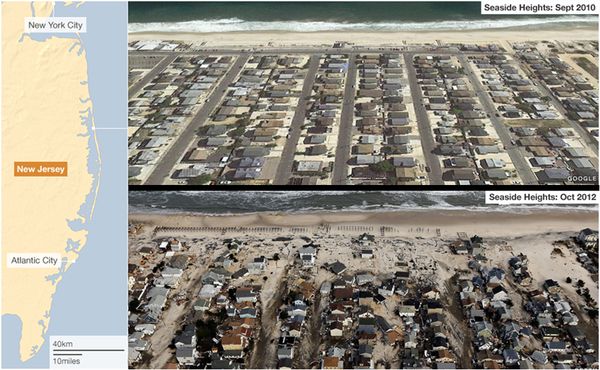
When I say “ignored,” it’s not that I pretend that this humble blog has any influence whatsoever on the policies of governments, it simply reflects the fact that the considered and rational voices of scientists who know what they are talking about continue to be not only ignored, but even defied, by the powers that be, national and local. I have often mounted my soapbox about coastal management issues in the past, generally amid the chaotic aftermath of the latest hurricane (or, as the case may be, “superstorm”). A good starting point in the archives, should you be interested, would be “Our own little bridge to nowhere,” from March of this year; in there are various links to the views and advice of experts such as Rob Young and Orrin Pilkey.
So, in the aftermath of the unfortunately named Sandy, I can only reproduce – somewhat forlornly - a piece by Young and his colleague from USA Today a couple of days ago:
Sandy reminds us of coastal hazards
Rob Young and Andrew Coburn
Our governments encourage rebuilding in vulnerable areas – at a large cost to taxpayers.
Story Highlights
- Hurricane Sandy represent a chance to reassess and improve future coastline exposure.
- A new study showed that New York and New Jersey among states most vulnerable to sea level rise.
- Blame our federal and state governments for encouraging rebuilding.
5:14PM EDT October 31. 2012 - Superstorm Sandy will almost certainly join the pantheon of “costliest storms in history.” The impact of the storm has been felt from South Carolina to southern Massachusetts. There has been massive damage to significant segments of the New Jersey and New York coastline.
As hard as it may be to think about while people are still being plucked from rooftops, storms such as Sandy represent an opportunity to reassess and improve future exposure of coastline communities to storms and ocean surges.
For example, let’s take the hardest hit coastal area from Sandy – New Jersey and New York. A study released in March 2012 by Ben Strauss and Climate Central, which does research on climate change, listed New York and New Jersey among those states most vulnerable to sea level rise. These shorelines will only become more vulnerable with time, and more costly to maintain.
Even New Jersey Gov. Chris Christie agrees. When NBC’s Brian Williams on Tuesday night asked Christie about the power of Mother Nature, and rebuilding the Jersey Shore, he said: “There is a way to do it, but we’re going to have to sit down and be smart about it. … One of the things I’m going to be talking with President (Obama) about … is bringing the Army Corps in immediately to talk to us about how’s the best way to rebuild the Jersey Shore.”
Of course, predicting the likelihood of wind damage 50 miles from the coast is impossible, but we have a far better grasp today of the impact of coastal flooding and erosion. Every coastal community has its hazard hotspots, and yet we still have failed miserably in keeping development out of these highly vulnerable areas.
How can we keep repeating the same mistake? The federal and state governments provide multiple incentives for homeowners and businesses to rebuild, rather than relocate.
The continuing saga of Dauphin Island, Ala., is a notable example. The west end of island is arguably the most vulnerable shoreline in the United States. It has been impacted by tropical storms 10 times since Hurricane Frederic in 1979. Though it was spared Sandy’s wrath, it is still recovering from damage from Hurricane Isaac in late August. The cost from the previous 10 storms to the federal taxpayer was approximately $80 million for an area of about one square mile with only 400 homes.
The funds for this rebuilding come largely through the public assistance sections of the 1988Stafford Act. This law created the federal system of emergency response that we are all so familiar with. When the president makes a federal disaster declaration for a county, aid dollars flow in with few strings attached. And, as with Dauphin Island, those dollars are often used to replace the same infrastructure over, and over again.
The Federal Flood Insurance Program, administered by the Federal Emergency Management Agency (FEMA), provides vulnerable properties access to flood insurance that would not be available in private markets. Many states have government-managed “wind pools” to keep the rates for non-flood property insurance artificially low. The largest insurer of coastal property in Florida is the State of Florida through its Citizen’s Property Insurance Corporation. Private losses not covered by insurance are often written off at tax time, an indirect federal subsidy of risky development.
Finally, federal and state taxpayers have spent billions of dollars over the last four decades pumping up beaches in front of coastal properties (beach nourishment) and constructing coastal protection projects. In New Jersey alone, approximately $1 billion in public funds have been spent just to keep beaches in front of homes and oceanfront buildings.
Even more mind-boggling is the fact that FEMA treats beach nourishment projects as infrastructure. If a storm washes away your beach, taxpayers will put it back. One of the hidden costs of Hurricane Sandy up and down the East Coast will be the federal funds used to put the sand back in front of the houses.
It really shouldn’t be like this. Taxpayers should not be subsidizing the risk of irresponsible development, and we clearly shouldn’t be rebuilding areas of known hazard multiple times. We need to allow market forces to set insurance rates and property values without the current government subsidy and risk underwriting.
Superstorm Sandy is a chance to change that calculus. Let’s hope that federal, state, and local governments can come together to rebuild infrastructure in a way that will reduce future vulnerability, and limit taxpayer exposure.
Ultimately, let’s hope that government at all levels can finally take the issue seriously. Every storm like Sandy is an opportunity to change the way we have been doing business. Let’s take it.
Rob Young is director and Andrew Coburn is associate director of the Program for the Study of Developed Shorelines at Western Carolina University.
So we’ll wait and see – perhaps after the next hurricane….
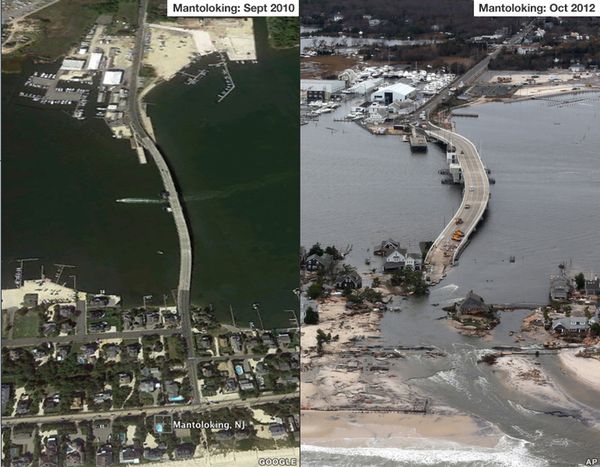
Meanwhile, there’s a good post at Geology in Motion on “Why did Sandy leave so much sand in Seaside Heights and even NYC?” and a useful explanation of what a storm surge is at Geology.com.
[Images courtesy of the BBC and AP]
Comments
Full version of Gov. Christie’s comment, quoted above:
“As a kid who was born and raised in this state and who spent a lot of time over my life, both my childhood and my adult life, at the Jersey Shore, we’ll rebuild it,” he said. “No question in my mind we’ll rebuild it.”
The text about putting away childish things does not seem to have occurred to him.
A surprisingly practical economics-based response in BloombergBusinessWeek: here:http://www.businessweek.com/articles/2012-11-01/hey-chris-christie-dont-rebuild-in-harms-way
Then again, Mayor Bloomberg has announced that readying for climate change should now be part of urban planning. Then again, his administration has promoted waterfront development in New York City, as noted in this story, which indicates that the Christie Doctrine does face doubters:
http://www.nytimes.com/2012/11/04/nyregion/after-getting-back-to-normal-the-big-job-is-to-face-a-new-reality.html?pagewanted=all&_r=0
So perhaps there is a point at which short-sightedness becomes too expensive? One would like to hope so.
Don’t overlook the role of the banking industry in this as well. Pumping up the valuations of coastal properties so they can carry profitable (to the banks) debt is one of the cornerstones of the financial system.
I wrote an entry here (http://worldcomplex.blogspot.com/2012/04/natural-and-keynesian-disasters.html) which was more about the relationship between declared disasters, tornadoes, and urban sprawl, but the argument is similar.