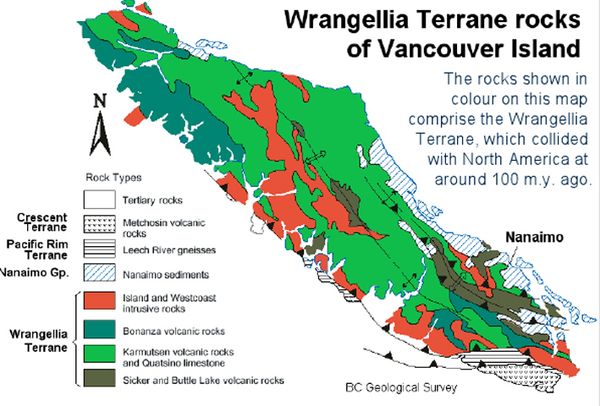
A hundred million years ago, over the western ocean horizon, loomed yet another impending tectonic disaster. A gigantic plateau of volcanic rock was lurching its way eastwards towards an inevitable collision with North America, the oceanic plate that carried it being consumed beneath the continent. The plateau was far too massive to be digested, instead winding up accreted – welded, glued, uplifted – to an ever-expanding continent to form, amongst other things, the backbone of what is today Vancouver Island.
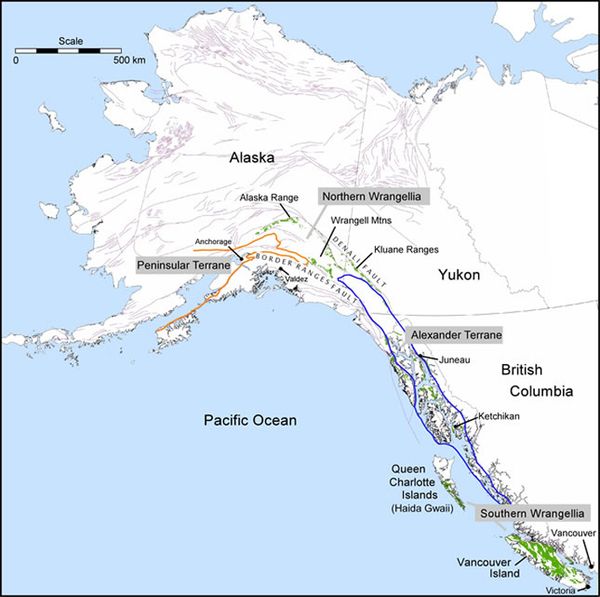
This collision and continent-building event took place along the entire stretch of western Canada and Alaska, one chapter in the saga of tectonic chaos that would continue along the whole margin of North America to the present day. It wasn’t simply one plateau of volcanic rocks that blundered into its final resting place, but a complex of oceanic bits and pieces, deep marine sediments, cherts, limestones, geo-flotsam and geo-jetsam, different terranes that have come to be grouped together under the name Wrangellia, after some fine examples in Alaska’s Wrangell Mountains:
In the vicinity of Vancouver Island, the Wrangellia terrane was uplifted and rapidly eroded, sand and mud pouring off the new mountains to form deltas and marine deposits, shallow and deep, accumulating to a thickness of five kilometers. This pile of sediments is referred to as the Nanaimo Group, and underlies much of the south-eastern coast of Vancouver Island, where a colleague of mine is lucky enough to live (when he’s not being a colleague of mine and working in Indonesia).
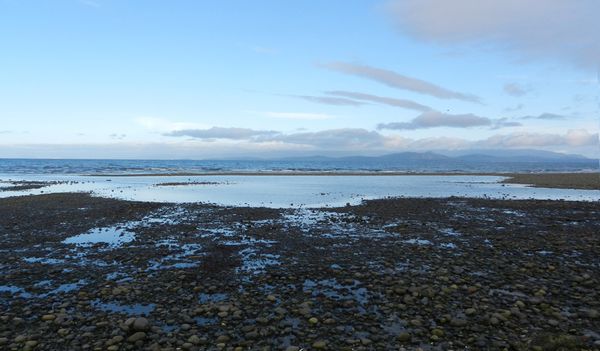
He looks out eastwards over the deliciously named Salish Sea to the hills of Lasqueti Island and the mainland, across a beach that is a broad bench, strewn with cobbles, pebbles, and gravel – between which can be found today’s Sunday Sand.
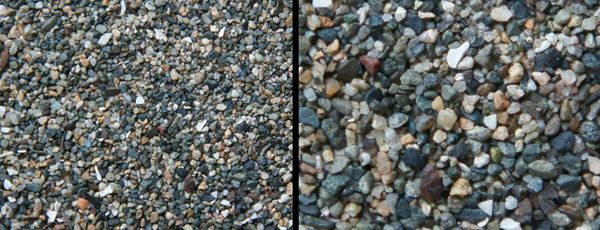
And, as usual, this sand consists of local ingredients, detritus of Wrangellia – and the detritus of the detritus of Wrangellia. It’s a young, angular, coarse sand, the grains not yet well-travelled – the photos are of the sample sieved to collect only the sand-sized fraction. The grains are of grey and greenish volcanic rock, originally erupted on to the floor of the ancestral Pacific Ocean, 200 million years ago, deep-sea sediments, red chert fragments, bits of limestone, the odd quartz grain, the occasional piece of broken shell.
The story of Wrangellia, recounted by this sand, was but an early episode in an ongoing series of events in which successive wandering foreign tectonic chunks accreted themselves to Western Canada – the Pacific Rim Terrane, the Crescent Terrane. And, as this cross-section shows, it’s still going on today. Out in the ocean, far to the west of Vancouver Island, lies the true edge of North America, sediments and oceanic material scraped off the top of the subducting Juan de Fuca Plate, in the fullness of time to make their contribution to the territorial expansion of Vancouver Island.
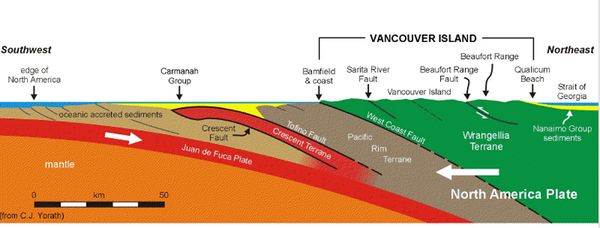
[Illustrations from Steven Earle’s The Geology of British Columbia and Vancouver Island – if you, like me, can’t get to the original, try the Google “quick view” version ; for more on Wrangellia, see this University of British Columbia site; and thanks, Brett, for the sand!]
Comments
Michael,
Thanks for that very interesting perspective.
Brett
OT, but google are showing some love to Geologists today!
Homepage link to Steno, with a cute illustration. Wish I’d drawn it!
“The fullness of time”–among several reasons I’ve been hors de conversation lately has been classes for volunteers in disaster response, specifically what to do when The Big One comes to the Puget Sound region, courtesy of subduction. Of precautions, the most sensible would be to live somewhere on the stable interior craton, but surface is good here. Considering one of your periodic topics, why people insist on inhabiting high-risk terrain, one might reinterpret A.E. Trueman’s title, Geology and Scenery. The busier the one, the nicer the other, generally.
Re busy and nice, with my current (occasional) views of Rong of Fire Volcanoes, I can only agree!
I’d be interested in hearing more about your disaster response training experience.
It’s a national program: http://www.citizencorps.gov/cert/
that adapts to local circumstances; on the Atlantic coast, they spend less time preparing for temblors, more for floods. A few hours a week in class, for two months, learning basic skills; an emphasis on organizing neighbors and preparing communities to fend for themselves while professional services cope with high-priority problems; lots of checklists. The garage is now full of bottled water, and we have hard hats and flashlights by the bed.
Experience: there’s a gradient combining time and knowledge. The more people live in the present, the less they like uncertainty or want the skills that acknowledge risk. I’ve been impressed by the ways that good teachers and organizers get past this reluctance, often by using community social bonding as present-time reinforcement. Up near Mt. Rainier, the schools have lahar evacuation drills, which students appreciate as a chance to get out of the building.
Enjoy those nice views.