I have been offline for a while, living the life of a hermit attached to a word-processor, surrounded by a veritable chaos of index cards, large sheets of paper covered in my version of ‘mind-maps’, magazine clippings and journal articles, all of which required consolidation into some kind of coherent story. More of this later, but I had not completely removed myself from the real world and last week, when I happened upon a BBC news story titled ‘Sumatra coastal cave records stunning tsunami history’, I thought that this was a sand story that had to be told, a perfect opportunity to return to posting.
I wrote a couple of pieces in the aftermath of the 2011 Tōhoku-oki earthquake and tsunami, discussing some of the fascinating research that was going on and wondering why the geological record of tsunami events along that part of the Japanese coast had been so flagrantly and catastrophically ignored. The testaments of past tsunamis around the world (together with earthquakes and, indeed, hurricanes and volcanic eruptions) demonstrate with irrefutable clarity the utter nonsense of talking about a ‘hundred year’ or a ‘five hundred year’ event and the tragic consequences of incorporating such assumptions into any kind of planning process.
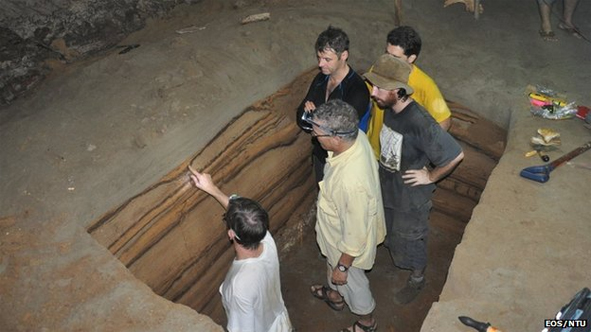
Jessica Pilarczyk is a member of an international team that has investigated the sediment records of past tsunamis, including the Jōgan event of A.D. 869 that devastated the Sendai coastal plain to essentially the same extent as the tsunami of 2011, yet seems to gone missing from the minds of Japan’s nuclear facility planners. Now, at the recent meeting of the American Geophysical Union, Pilarczyk and her colleagues have described their findings from an extraordinary cave on the Sumatran coast. Situated above modern tide levels, the cave is nevertheless filled with layer after layer of sand, separated and sealed by layers of bat guano (the innocuous looking dark layers in the trench in the photo above). Storm deposits? Unlikely, because, as Pilarczyk’s meticulous analysis has shown, the sand contains the shells of microscopic marine creatures, foraminifera, that live only on the seafloor where the water depth is greater than 20 meters – well beyond the ability of waves to scour the sediment, even in the biggest storms. The sand can only have been excavated from the sea bed by a tsunami, carried inland and dumped in the cave. The oldest tsunami sand dates from around 7,500 years ago, but the most recent is 3,000 years old – the cave filled up, there was no longer room to dump more sand and so younger deposits, including the debris from 2004, were instantly eroded. The bat excrement preserved the older record, but of course today’s inhabitants of the cave make it a less than delightful place to work; I have spent time in bat-infested caves in the rain forests of Kalimantan and can vouch for the challenges of such an environment.
But the work and the results are extraordinary – more than 4,000 years of detailed tsunami records, dated and documented. It’s a story that should be required reading for anyone delusional enough to believe in the ‘five hundred year’ event, and certainly for everyone upon whose actions people’s lives depend. The Sumatran cave record reveals a period of 2,400 years during which there were no tsunamis, followed by a sequence of five in 400 years.
Here is the BBC article by Jonathan Amos, and a description of more of Pilarczyk’s work can be found at http://www.earthexplorer.com/2013/Was_that_a_tsunami_or_a_hurricane.asp.
A cave on the northwestern coast of Sumatra holds a remarkable record of big tsunamis in the Indian Ocean.
The limestone opening, close to Banda Aceh, retains the sandy deposits washed ashore by huge, earthquake-induced waves over thousands of years.
Scientists are using the site to help determine the frequency of catastrophes like the event of 26 December 2004.
This is being done by dating the cave’s tsunami-borne sediments, which are easy to see between layers of bat droppings.
“The tsunami sands just jump right out at you because they’re separated by guano layers. There’s no confusing the stratigraphy (layering),” explains Dr Jessica Pilarczyk.
“It makes for interesting field work; I’m not going to lie to you. The bats get very excited when people are disrupting their space. But from a geologist’s point of view, this cave has the most amazing stratigraphy,” she told BBC News.
Dr Pilarczyk was speaking here in San Francisco at the American Geophysical Union (AGU) Fall Meeting, the world’s largest annual gathering of Earth scientists.
She is part of a team of researchers - led by Prof Charles Rubin - from the Earth Observatory of Singapore, an institute of Nanyang Technological University that is investigating the coastal history of Indonesia’s largest island.
Sumatra’s proximity to the Indo-Australia and Sunda tectonic plate boundary, and the giant earthquakes that occur there, means its shores are at risk of major inundations.
Understanding how often these occur is important for policy and planning in the region.
The Acehnese cave lies about 100m back from the swash zone at current high-tide. Its entrance is also raised somewhat, and this prevents all waters from getting into the opening - apart from tsunamis and severe storm surges.
Dr Pilarczyk and colleagues have dug trenches through the alternating bands of bat guano and sand to piece together the cave’s history.
The scientists know they are looking at tsunami deposits because they can find debris in the sediments of seafloor organisms such as microscopic foraminifera. Only the most energetic waves could have lifted and carried this material into the cave.
The investigations are ongoing but the team thinks it can see deposition from perhaps 7-10 tsunamis. The geometry of the cave means these events would likely have been generated by earthquakes of Magnitude 8, or more. By way of comparison, the devastation wrought by 26 December 2004 stemmed from a M9.2 tremor.
Dating the old deposits is obtained by radiocarbon analysis of organic debris caught up in the bands, such as molluscs and pieces of charcoal from old human-lit fires.
Work is under way to date even the insect remains eaten by the bats and now immersed in the guano layers.
Today, the cave is so full of sand and bat droppings that any new event will essentially overwash and erode the most recent deposits. “The 2004 tsunami completely inundated the cave,” comments Prof Rubin.
Nonetheless, the stratigraphy from about 7,500 to 3,000 years ago is impeccable.
“What we think we have is actually a near-complete sequence of late-Holocene deposits. This is amazing because usually the records we have are fragmentary at best. This coastal cave is a unique ‘depocentre’, and it’s giving us a remarkable snapshot of several thousands of years, allowing us to figure out every single tsunami that would have taken place during that time,” said Dr Pilarczyk, who is affiliated also to Rutgers University, US.
The team’s other investigations along the Acehnese coast are filling in the period from 3,000 years ago to the present.
And the take-home message from all this research is that the biggest tsunamis are not evenly spaced through time. Yes, there can be long periods of quiescence, but you can also get major events that are separated by just a few decades.
Co-investigator Prof Kerry Sieh says this is a cautionary story.
“2004 caught everybody by surprise. And why was that? Because nobody had been looking back to see how often they happen, if they’d ever happened,” he told BBC News.
“In fact, because people thought they had no history of such things, they thought it was impossible. Nobody was prepared, nobody had even given it a second thought. So the reason we look back in time is so we can learn how the Earth works and how it might work during our watch.”
The cave research also involves scientific input from Syiah Kuala University in Banda Aceh.
Comments
“I have spent time in bat-infested caves in the rain forests of Kalimantan”–isn’t that the beginning of a novel by Joseph Conrad?
Thank you, Michael, for bringing us news of this marvelous research. And congratulations on bringing order from chaos, yourself from isolation(“Like nature’s patient, sleepless Eremite”), and sense from the nonsense of the “thousand-year event.”
How many books have been published in the last decade, explaining the difference between power laws and periodicity, and how much effect have they had on public policy? Bats, alas, are not the only species living with their own guano.