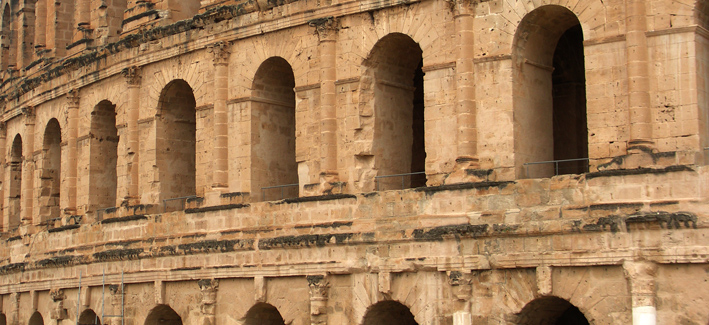
As our group stood in the rain in the great arena of the stunning Roman amphitheatre at El Jem in Tunisia, guess who volunteered the fact that “arena” is the Latin for “sand”, reflecting its capacity for soaking up the blood?
The weather was hardly ideal, but the conditions could not detract from the wonder of this place. It’s a World Heritage Site and it thoroughly deserves it. This was the latest and grandest of three such buildings that had stood on this site, and was built nearly 1800 years ago. Built to last, in spite of everything - the weather, becoming a fortress and a refuge for the Berbers during wars with the Arab invaders, and being bombarded by the Turks in a conflict over taxes - plus functioning as a quarry for centuries.
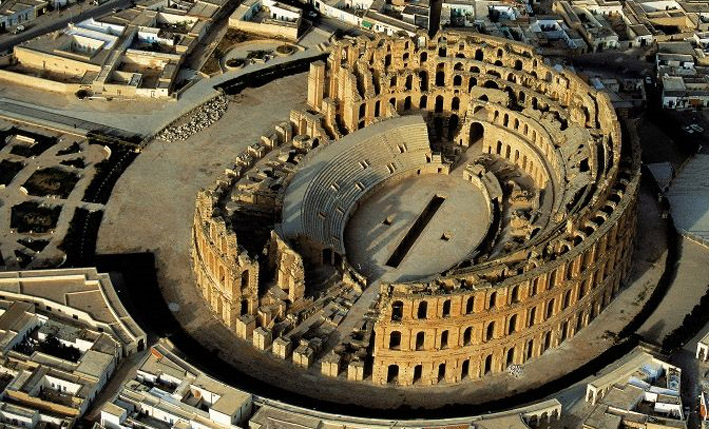
[photo: Jann Arthus Bertrand]

The design is elliptical, the whole building measuring 148 by 122 metres, the arena 65 by 39 metres; with a capacity bloodthirsty crowd of more than 30,000 and perhaps up to more than 40,000 it’s considered the third largest amphitheatre in the world - it’s not as big as the Colosseum in Rome, but it’s arguably better preserved and just as magnificent. It is, frankly, awe-inspiring.
There was no limestone, the Romans’ favourite building material, easily available in that part of Tunisia, so a sandstone from quarries 30 kilometres away, close to the coast, was used. And the extraordinary thing is that this sandstone is incredibly young - geologically - having formed in the Pleistocene period a mere 125,000 years ago when northern Europe was in the grip of the Ice Ages. It’s a coarse-grained sandstone, with everywhere beautiful examples of cross-bedding on all different scales (see photo below).
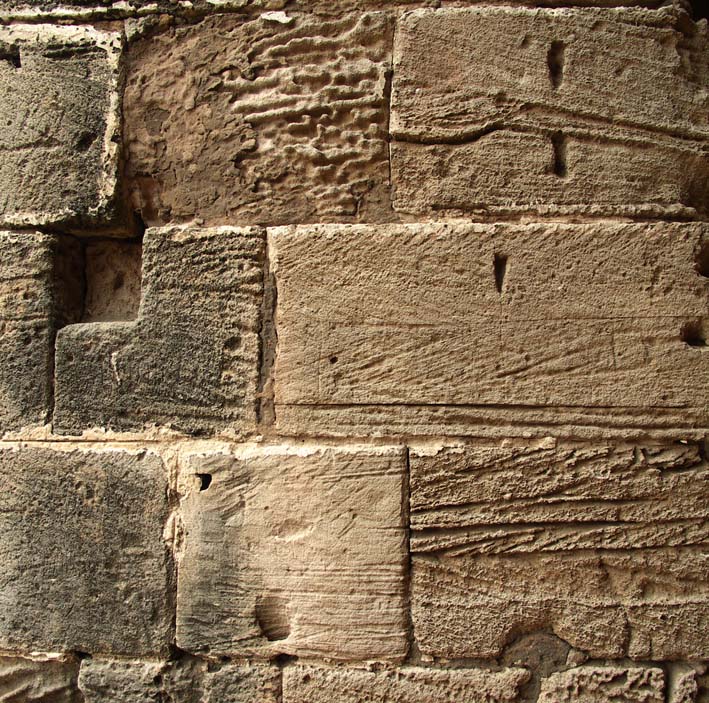
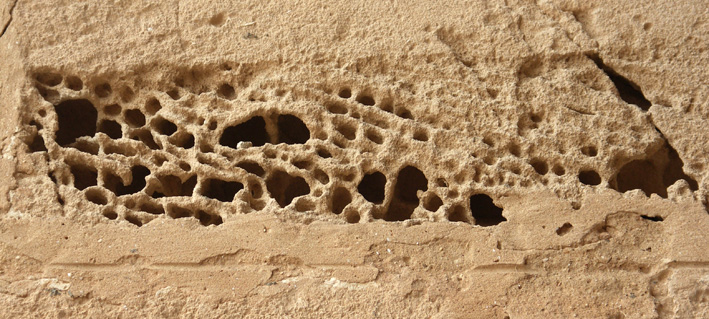
These sandstone blocks are from what is referred to as the Rejiche formation, named after the hill from which the stone has been quarried. It’s a very calcareous sandstone, with shell fragments and ooids, tiny spherical or egg-shaped (hence the name) grains of calcium carbonate that formed chemically in warm seawater highly saturated in dissolved minerals. These sands were formed in shallow marine conditions, but also in coastal dunes, and they were cemented early on in their history by water percolating through them, dissolving and re-precipitating the calcium carbonate. So, young though they are, they, combined with the skills of Roman construction methods, could make buildings built to last. Their surfaces do, however, weather - quite often to form miniature tafoni patterns (see this and other posts on these natural sculptures):
But the immense structure of El Jem, with walls close to 5 metres thick, was not just constructed out of these sandstones. Bricks were used for some of the vaults, as well as concrete. Now I knew something about the Romans and their skills at making concrete and referred to this in the book:
The recipe for basic concrete is simple and has been around for a long time. The ancient Egyptians knew how to make it (there is a lively debate as to whether the pyramids, at least in part, are made of concrete), and the Romans perfected the formula. The fundamental ingredients are around 75 percent sand and gravel, 15 percent water, and 10 percent cement. The cement, cooked from materials such as limestone and clay, is the chemical glue; the hardening of concrete is not simply due to drying, but involves complex chemical reactions. The physical characteristics of the sand, its size and shape, influence the properties of the concrete, but because of the importance of chemistry, the composition of the sand and the other ingredients is critical. The wrong impurities will ruin the quality of the concrete.
But, coincidentally, in the April issue of Earth Magazine that recently came through the door, there’s an article on “Why Roman Concrete Stands the Test of Time,” and it’s fascinating. I don’t know if they imported it into North Africa (but given how much specialty material the Romans did import, I wouldn’t be surprised), but a specific deposit of volcanic ash was consistently used as the chemically magic ingredient. The ash, from an explosive eruption around 450,000 years ago, 20 kilometres from Rome, is also known as pozzolana, after the location. Using it instead of Portland Cement makes for very different properties of the resulting concrete, some advantageous, some less so. But the Romans certainly did perfect this technology - it has stood the test of time and using pozzolana is a far less energy-intensive process than that of making Portland cement, offering some real possibilities for improving modern technology.
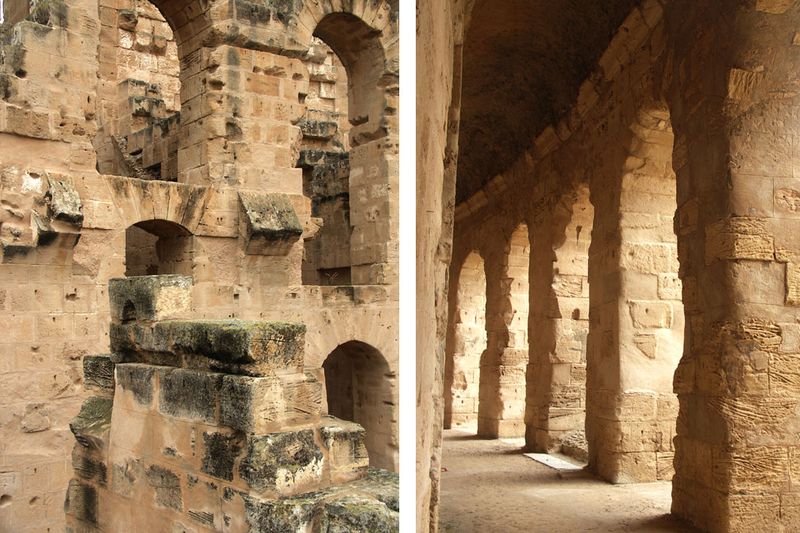
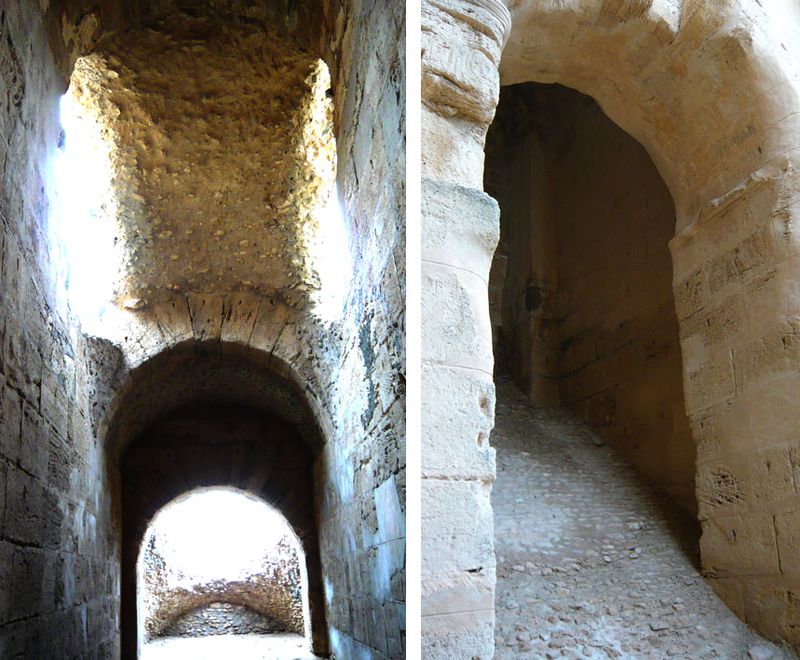
The photos below show (not very clearly, I’m afraid - the lighting was not great) very crude-looking concrete ceilings and their upper side viewed from above. They have certainly stood the test of time.
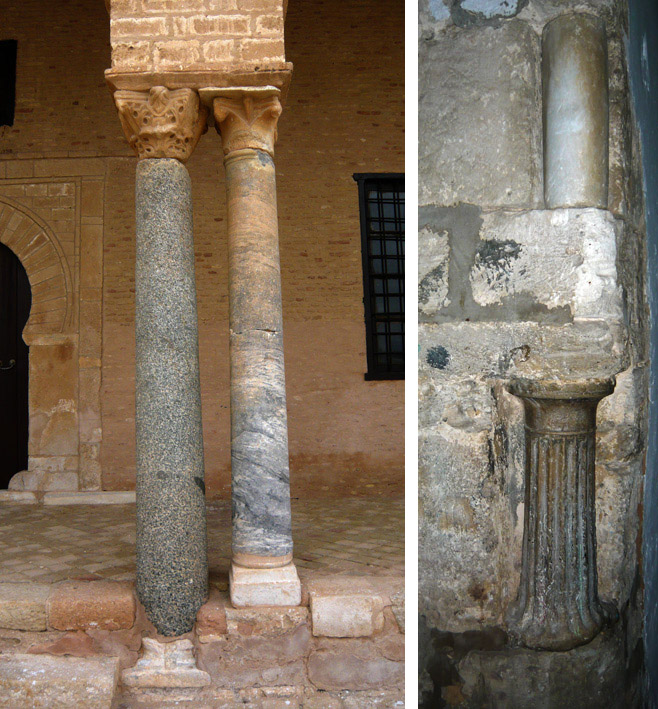
The stone for El Jem may have been quarried locally, but the structure itself later became a quarry - a source of building materials to be utilised far and wide throughout Tunisia. We kept coming across bits and pieces - sometimes substantial pieces - of Roman stone cannibalised and incorporated into houses and medinas, kasbahs and mosques, wherever we went, including Tozeur, nearly 300 kilometres southwest of El Jem. Now clearly there were endless sources of Roman materials in addition to the amphitheatre, but it does seem tragic that such a magnificent construction should be used as the local DIY store.
The idiosyncratic examples of cannibalisation below are from the Greta Mosque at Kairouan and the medina at Sfax.
Comments
Michael,
Great posting and I love the last shots of the cannibalized columns. Quite attractive, actually. As you know, cannibalism of stone is a common practice. The one I am most aware of is the use of the Colosseum as building stone quarry in the 1500s and 1600s. It would be interesting to trace the history of this and see how it relates to other threads of history.
Cheers,
David
What an awesome, awe-inspiring design - and to think it’s 1800 years old! what is that saying about “castles made of sand…”?
The history is mind boggling, too.
Hera