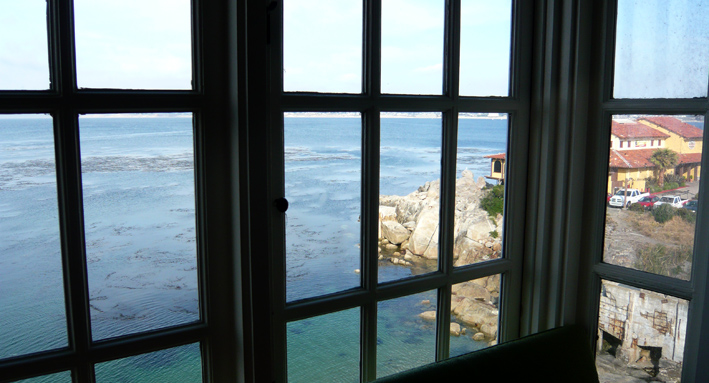
Late in the evening in Berkeley, after four great days of wandering up California. Many stories to tell that require greater focus than I have right now, but will be the subjects of later posts. For now, Monterey, where we stayed last night, returning after more than twenty years. Cannery Row, its romantic and literary connotations now totally submerged in truly dreadful tourist claptrap (with the exception, of course, of the aquarium and one place that I’ll be writing about later), still offers the opportunity to turn your gaze away from commerce gone mad and look out across the great sweep of Monterey Bay accompanied by the background songs of the sea lions.
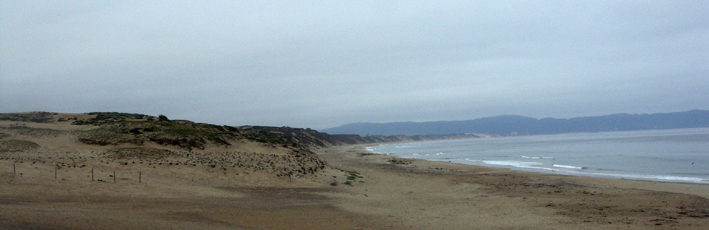
We stayed on Cannery Row for the view, spectacularly available from the Spindrift Inn (no, this is not a commercial, but I would recommend it); the view above is from our room. And as you gaze out over Monterey Bay, either from there or from the stunning dune systems further up the coast (below), it’s worth remembering that, hidden below the waters of the bay is one of the continent’s great topographic features - the Monterey Canyon. A couple of weeks ago, I wrote about sediment budgets and littoral cells; for every segment of coast, along which a “river of sand” is moving, there is an end of the road for that sand where it is removed from the budget, essentially permanently taken out of the system, and the most common fate is that it is flushed down a submarine canyon and out into the deep ocean.
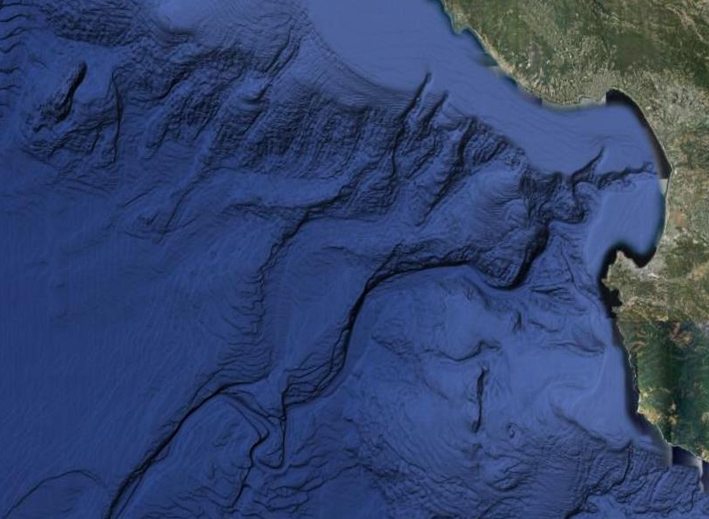
The Monterey Canyon is massive, its mile deep relief being comparable to that of the Grand Canyon, but two miles below the surface of the ocean; and it extends 95 miles out into the Pacific, ending in an apron of the sand and mud deposited after they have hurtled down its length. It has been estimated that a dump truck load of sand is flushed down the Monterey Canyon every 17 minutes. The dramatic scale and extent of the canyon and its subsidiaries are superbly imaged by Google Earth, below.
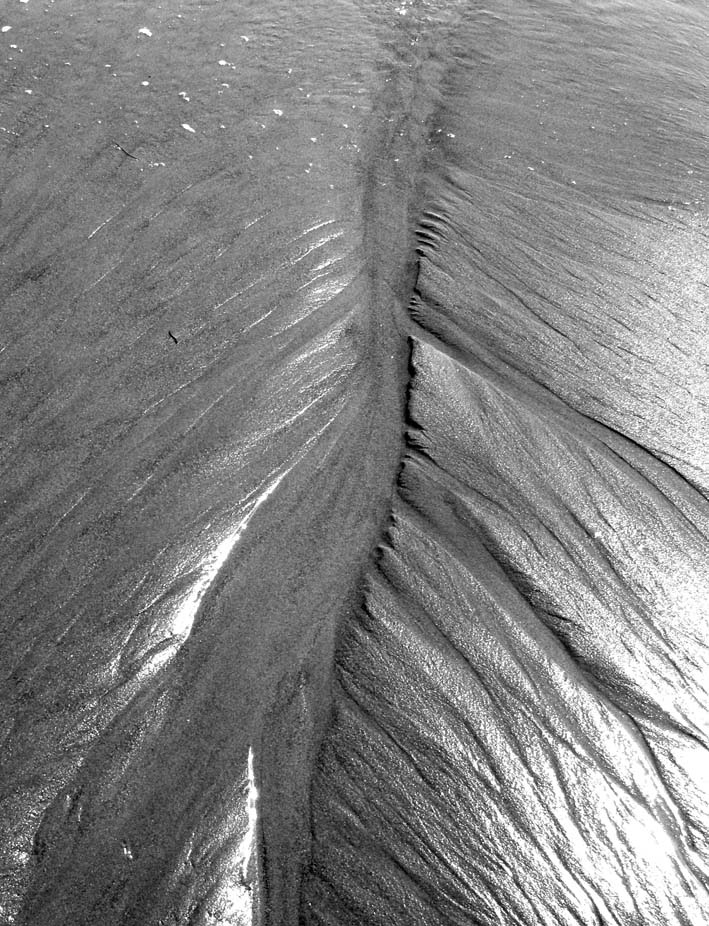
So the view westward from Cannery Row is enhanced by the thought of this hidden drama. But then again, processes on the beach on a scale orders of magnitude smaller can display their own, equally compelling and immediately accessible, canyon dramas.
Comments
next time you come through Berkeley, let me know
What’s the geologic history of the Monterey channel? I can hardly believe that Elkhorn Slough created all that. Or --?
What’s the element in the last photo called, and how does it evolve over time?
Hi Brian - I certainly will, and thanks! It was a fleeting visit this time, and involved seeing old friends.
Cheers
Michael
Hi Diggitt - thanks for the comment. I’m on the run at San Francisco airport at the moment so will try to answer your question in the next couple of days. Meanwhile, the black and white photo at the end is a miniature “canyon” I found on the beach earlier that day - I was struck by the similarities of nature’s architectural patterns regardless of scale!
Cheers
Michael
Diggitt … try this paper by Fildani & Normark that goes through the geologic history of the Monterey submarine fan. It doesn’t focus on the canyon itself, but may help answer some of your questions about geologic history.
Fildani, Andrea, and Normark, W.R., 2004, Late Quaternary evolution of channel
and lobe complexes of Monterey Fan, Marine Geology 206, p. 199-223.
You can get the PDF from USGS site here: http://walrus.wr.usgs.gov/reports/reprints/Fildani_MG_206.pdf
Michael … cool, would be good to grab a cup of coffee next time and chat about sand and Sand.