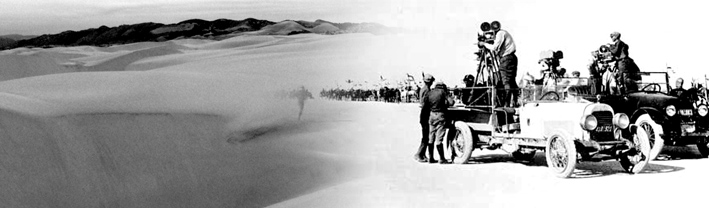
The dunes at Oceano that I visited and introduced in the previous post are but the northern tip of the eighteen-mile-long Oceano-Nipomo-Guadalupe dunes complex, the largest landscape of coastal dunes in California. Further south, the dunes are punctuated by lakes, marshes and the river channels that supply the sand to the coast for later redistribution by the wind. We know that coastal dunes differ from their desert relatives, but for movie-makers whose budget does not allow for a trip to the Sahara, California’s dunes provide a passable desert-replicating backdrop. They have played this role recently for the third in the Pirates of the Caribbean series, but have hosted many other dramas, including Hidalgo, G.I.Jane, and The Last Outpost with Cary Grant. However, their Hollywood heyday was much earlier - Rudolph Valentino stalked the dunes in the 1920s Sheik movies and Marlene Dietrich was transported across the sand in her car mounted on a sled since she refused to walk in the stuff during filming of Morocco with Gary Cooper in 1930. But the most famous and enduring role that 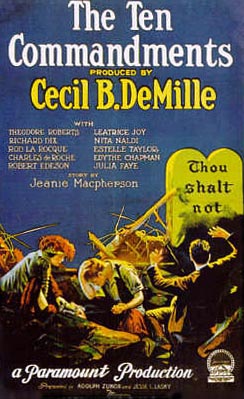 the Nipomo dunes have played was in Cecil B. DeMille’s first version of The Ten Commandments, arguably the first epic film, made in the silent era in 1923. For his 1956 remake with Charlton Heston and Yul Brynner, and Anne Baxter, DeMille went to Egypt, but for his original version the budget didn’t extend that far so he went to Nipomo. And there he built a truly epic set for the City of the Pharaohs and the Exodus scenes, and the remains of that set lie beneath the sands today.
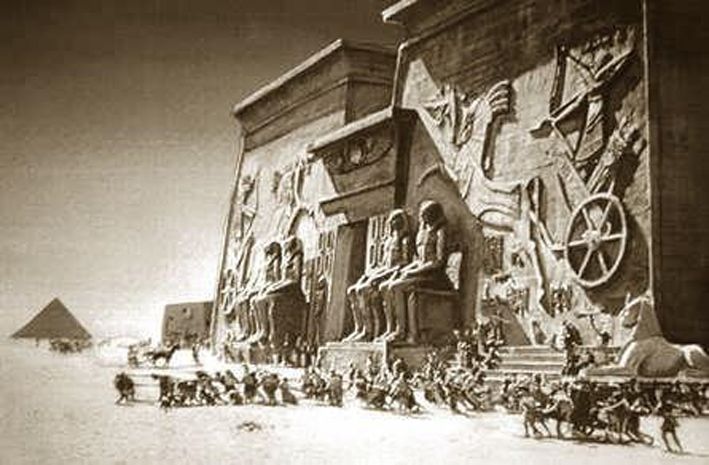
The movie had, for the times, an astonishing budget of $1.4 million which DeMille set about spending with abandon - it’s reported that, in response to telegrams expressing concern over his extravagance, he asked . “What do they want me to do? Stop now and release it as The Five Commandments?” He employed as his set designer Paul Iribe, a Frenchman who would later return to his native country and become one of the founders of the Art Deco movement. Tribe was certainly the man for DeMille’s epic vision. The temple wall, 700 feet wide, towered over a hundred feet above the dunes, decorated with hieroglyphics modelled on those recently discovered in the tomb of Tutankhamun; four 20 ton statues of the Pharaoh and 21 sphinxes were shipped in by train. On site for the month of shooting were 3,500 actors, 1,500 construction workers and 5,000 animals; a huge camp had to be built to provide living quarters. The weather was distinctly cold and actors had to have their skin coated in glycerine so as to appear to be perspiring in the Egyptian sun.
At the end of shooting, DeMille destroyed (bulldozed, some say dynamited) the set in order to prevent cheap and nimble competitors using it and possibly because he could not afford the removal required in his contract with the landowner. The remains were rapidly buried in the sand, but locals have long described a single dune that didn’t move - supposedly because it was anchored by DeMille’s debris.
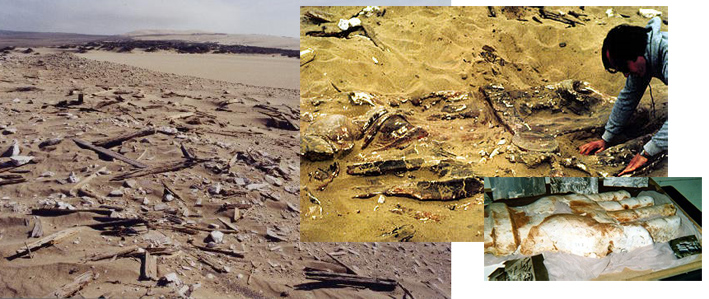
But then the El Nino winter storms of the 1980s arrived and stripped the sand away, revealing scattered fragments of the Pharaoh’s City. It was then that a documentary film maker, Peter Brosnan, spurred on by a comment in DeMille’s autobiography that future archaeologists might be seriously misled about an ancient Egyptian outpost on the California coast, teamed up with archaeologist John Parker, and began serious investigation. Amongst the scattered wood debris, they found fragments of the plaster statuary (including a Pharaoh’s foot), now degraded and fragile, together with tobacco tins and other artifacts from the 1920s. Ground penetrating radar helped them identify other large objects buried in the sand and define the area of the remains. A Pharaonic hand is on display at the Dunes Center in Guadalupe. Funds are still sought for a proper excavation of what is, arguably, a key cultural and cinematographic historic site, the largest movie set ever built at the time, partly exposed to the elements but largely still hidden beneath the California sands.
[see Brosnan’s site, http://www.lostcitydemille.com/index.html, from which some of the illustrations above come, The Center for Land Use Interpretation description of the archaeological site, http://ludb.clui.org/ex/i/CA4973/, a good description on Siffblog, and an NPR interview with Brosnan from a few years ago at http://www.npr.org/templates/story/story.php?storyId=4494713. For other movies starring sand, see my April4 post, Granular films, and thanks to Kevin, our Oceano guide, for bringing this story to my attention]
Comments
The gentleman who was hired by DeMille to design the sets is named Paul Iribe, not Tribe.
Apologies - typographical error now corrected - thanks for pointing this out!