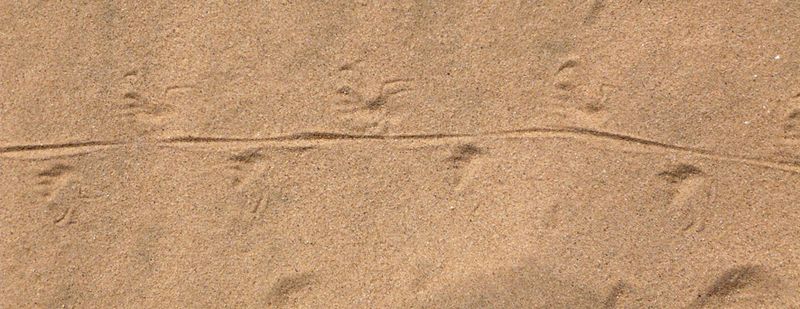
Anyone who clambers up the slip face of a dune becomes rapidly, and agonizingly, aware that locomotion in sand is a challenge. Even walking on the beach often requires a different kind of gait. Granular materials just make life difficult for humans, other critters, and vehicles (see the problems for Spirit, bogged down in the sands of Mars, Humphrey Bogart’s encounter with the angle of repose, or the travails of participants in the Marathon des Sables). For us, simply walking on sand requires around two-and-a-half times as much energy as on a hard surface - we’re actually better off running, which only takes one-an-a-half times as much effort (although my knees are reluctant to put this to the test). Yet there are large numbers of our companions in the world that are exquisitely adapted to locomotion on and in granular materials - at least under the right conditions. The complex networks of tracks and trails in the sands of the Kelso dunes reminded me of this (as I paused for breath), together with the impossibility of photographing fleet-footed lizards dashing effortlessly for cover at speeds that the eye can barely follow.
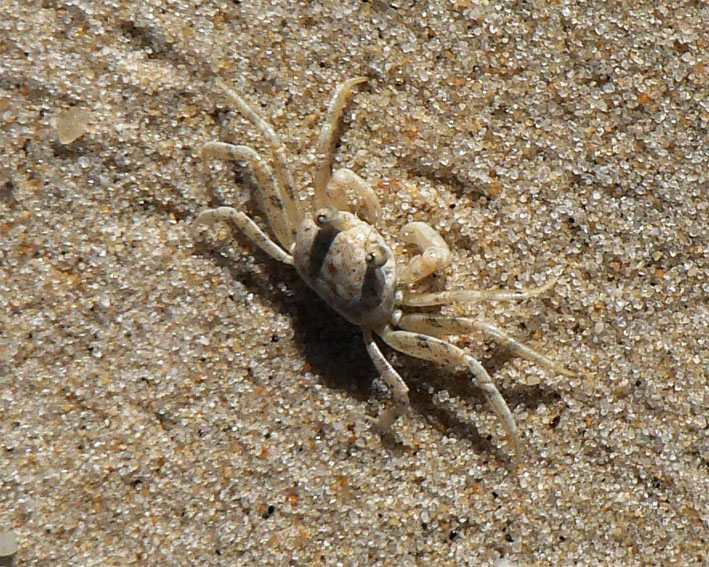 The ghost crab, so-named because of its ability to disappear instantly into the sand, and whose genus, Ocypode means “swift-footed,” is one of the record-holders in the granular olympics; in the right conditions, it can scoot across the surface at speeds in excess of five miles an hour, its small body becoming a blur. However, if the conditions are not just right and the sand is soft, the ghost crab runs into trouble and is swiftly overtaken by the zebra-tailed lizard who, although surprisingly does not spend a great deal of time in the sand, nevertheless can cope with
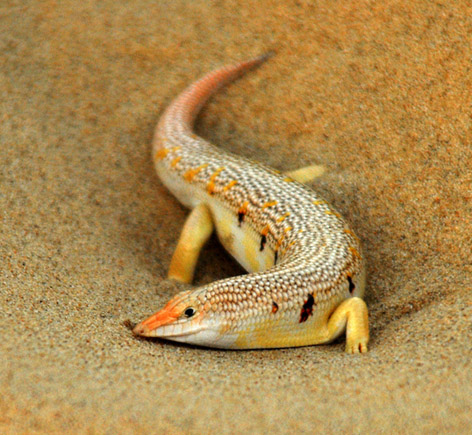
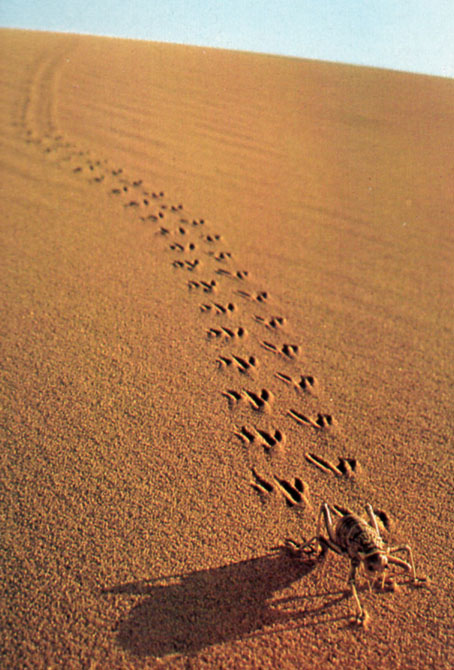
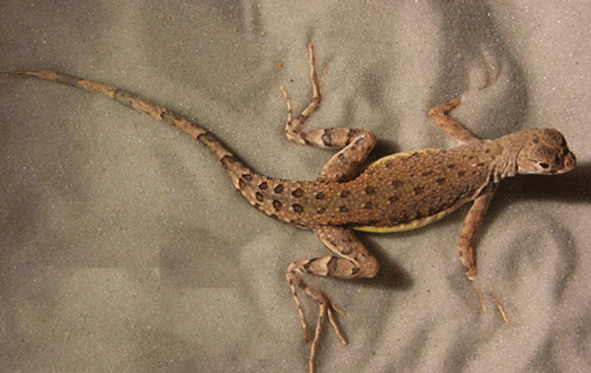 widely varying granular conditions, even quicksand. It would seem that the lizard’s talents derive from clever foot-design and actions, but the fact is that we’re not entirely sure (see http://www.sciencemag.org/cgi/content/full/315/5810/325). The variety of critters who are good at moving around in sand is equalled by the variety of ways in which they do it. Think of the snakes, the sidewinder for example, whose waving, looping motion leaves such unique and beautiful designs; or another lizard, the sand skink, also known as the sand swimmer or sand fish, which seems to have taken a kind of
  . Or consider the charmingly named itjaritjari, a strange little marsupial mole that lives throughout Australia’s deserts. It seems to have no eyes or ears, but put it down on the sand and it will disappear, as the Aboriginal people say, “like a man diving into water.” No one knows how the itjaritjari navigates or senses, but it has a hard nose and front feet well adapted to excavating, the back ones being webbed to help push through the sand; the young are carried in a pouch that cleverly faces backward so as not to fill up with sand. And then there are the insects.
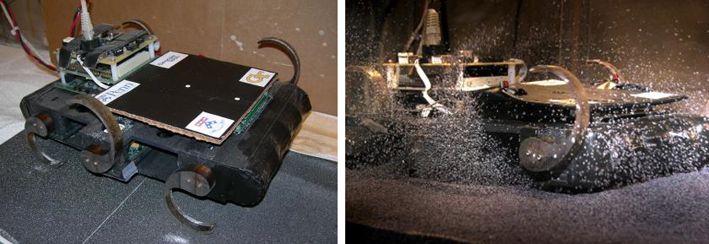
Trying to understand the skills of these expert critters is the focus of research around the world, for efficient locomotion in granular materials is critical in the realm of robotics, particularly for extraterrestrial explorers (as Spirit’s problems so dramatically illustrate). Daniel Goldman at the Georgia Institute of Technology in Atlanta was one of the researchers chasing ghost crabs and zebra-tailed lizards across laboratory sands in his pioneering work in the field of biomechanics, and he has now turned his attention to robotics. As reported earlier this year, Goldman, together with colleagues from the University of Pennsylvania and Paul Umbanhowar at Northwestern (who was extremely helpful to me as I was writing the book, trying to comprehend his extraordinary work on oscillons - no doubt the subject of a later post), has made real progress on designing a robot that doesn’t get bogged down. Their laboratory test bed track consisted of an eight-foot-long container filled with poppy seeds and with holes in the base so that granular material could be aerated and turned into variable types of fluidized bed with different densities. “We used poppy seeds as the granular material because they were large enough not to get into the SandBot motors but light enough to be manipulated with our air blowers,” explained Goldman. “We have done experiments with small glass beads, which more closely approximate desert sand, and found no qualitative change in the results.” The photo below shows the SandBot at rest and churning through the poppy seeds. The robot’s “legs” are C-shaped and their rotation characteristics variable. The ability of the robot to keep moving is highly sensitive to the density (and therefore the packing) of the sand and the frequency with which the wheels rotate. It will hardly be a surprise to any of us who have buried the wheels of a 4WD in the sand that the looser the material and the faster the wheels are rotating, the more easily will the robot bog down. As Goldman said, “changes in volume fraction [packing and density] of less than one percent resulted in either rapid motion or slower swimming. We saw similar sensitivity when we changed the limb rotation frequency.”
The Georgia Tech news release concludes with the following: Goldman “also plans to use the information to help roboticists design devices with the appropriate feet and limb motion to move well in complex terrain - including sand. Future robots may have the ability to sense the type of material they are walking across, allowing them to adjust their limb motion accordingly. Such smart robots would advance the exploration of other planets, as well as search-and-rescue missions in disaster settings.” This is important - and fascinating - stuff, worth contemplating next time you’re struggling up the face of a sand dune, gazing enviously at that lizard.
[The report on Goldman’s work linked above also contains some videos of the SandBot’s efforts, enjoyable viewing. Ghost crab image via Creative Commons license at mmhaffie’s flickr site, zebra-tailed lizard image, Madalyn Berns and ScienceMag, sand skink image credit Matt Gunner at flickr, sidewinder and cricket images, National Geographic]
Comments
I recently came accross your blog and have been reading along. I thought I would leave my first comment. I dont know what to say except that I have enjoyed reading. Nice blog. I will keep visiting this blog very often.
Lucy
http://smallpet.info
Hi Lucy - many thanks for the comment - it’s the kind of really satisfying feedback that makes blogging worthwhile. Glad you like it!
Michael