Everyone I have talked to who saw even part of the documentary recently shown in Europe expressed a common reaction: surprise. Which was exactly the intention of Denis Delestrac and all of us who were involved: sand as a non-sustainable resource?
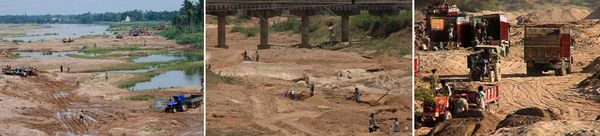
Illegal mining of sand from rivers and beaches is rampant – and big business – around the world, and nowhere more so than India. The courses of rivers are changed, people’s livelihoods ruined, ecological havoc induced, and there have been deaths. It is a major and complex issue for the country – there is money to be made by local people and governments as well as by the mafia. Attempts to shut down operations are often opposed, sometimes violently, by villagers for whom the extraction of sand is an important source of income.
As a matter of curiosity, I browsed the internet news sources and, as a sign of the scale and complexity of the problem, the following is but a sampling of stories extracted from only the last month.
-
Sand policy a formality in Hassan; mafia continues its rule
A sand policy is in place in the district to check illegal sand extraction and to protect the interest of both the people and natural resources. However, the district is in the grip of ‘sand mafia’ and the officials have turned a blind-eye towards it.
Three rivers — Yagachi, Hemavathy and Cauvery — flowing in the district are a boon not only for farmers but also for the sand mafia. The river beds are being dug up day and night for the past few years to satiate the greed of the mafia. At least a hundred sand-laden lorries leave for Bangalore every night. Political leaders of all parties are behind the mafia, so, officials think twice before taking any action. And, when they take action, the violators are alerted well in advance, through their sources.
-
Hurt real estate sector reeling under sand bans
MARGAO: The construction industry in Goa is reeling under a double whammy - an economic slowdown-infused buyer’s market and a debilitating shortage of construction material, especially sand. While the state government has banned the extraction of sand in Goa, the Karnataka government has banned its transportation to Goa. These developments have led to a severe scarcity of this fundamental construction material and an over 100% escalation in its price. There’s also a paucity of other construction materials such as stone aggregate, rubble and laterite stones.
-
Authority pulls down sand mafia bridge in Greater Noida
GREATER NOIDA: Toughening its stand against the sand mafia, the Gautam Budh Nagar district administration on Friday demolished an illegal bridge put up by miscreants near Gulavali village in Greater Noida.!
On receiving a tip-off about the unauthorized bridge constructed to transport illegally-mined sand, police and mining department personnel reached the spot and took around five hours to pull down the bridge.Police said the men involved in the illegal dredging of the river bed fled as soon as cops and department officials reached the spot. Officials are trying to find out if similar bridges have been made elsewhere.
-
Illegal sand mining: 32 tractors seized
Officials seized 32 tractors in Khammam district for illegal sand quarrying in Sarapaka village in Burgampadu and Chintakani mandals on Saturday night and Sunday.
The officials received information that some persons were illegally transporting sand in 20 tractors in Sarapaka village.
-
Squads to check illegal sand mining in district
PUNE: The district administration has appointed 13 squads, one for each taluka, to keep a check on illegal extraction of sand from rivers and its transportation following a rise in the number of cases of illegal transportation of sand. Besides, staff has been deployed at almost all check posts along the district border to identify sand trucks entering or leaving without proper permits.
Illegal extraction of sand is on the rise as most river beds in the district have gone dry due to water scarcity. The administration has identified 340 extraction spots in the district. However, sand extraction during the ongoing season is not permitted at any of the spots, as all sites are awaiting environmental clearance.
“If any such activity is under way in the river beds, it is illegal,” said an official of the district mining department. Officials said that the administration has undertaken repeated drives to restrict illegal sand mining. However, they said, staff on duty often faced stiff opposition from people involved in illegal activities. Officials have also faced physical assaults during raids and searches. Many a times extraction work is carried out during the night and in remote spots, which makes it difficult for the poorly equipped staff to initiate action, they said.
-
Tough cop shunted out at behest of sand mafia
NANDIGAMA: The sand mafia seems to have flexed its muscles again and succeeded in shunting out a sub-inspector who took them on in Nandigama, an area that has emerged as a goldmine for sand smugglers.
SI S Ramakrishna had acted swiftly against sand contractors carrying out sand poaching on the banks of river Krishna at Nandigama. But the officer’s posting in the town lasted only 40 days, thanks to the government allegedly buckling under the pressure of the local sand mafia, which is said to be controlled by politicians cutting across party lines.
-
Ghariyal population rising in Chambal
LUCKNOW: The new ghariyal hatchlings at the national chambal sanctuary give a boost to ghariyal conservation. After more than 100 ghariyals died in  Chambal between December 2007 and March 2008, their number has increased to 785, at present, from 300-odd ghariyals three years back. One of the major reasons why ghariyal population is going down is the destruction of the habitat. Illegal sand mining and illegal fishing along the banks of Chambal river destroy the habitat of ghariyals.
“These are the two direct threats to ghariyals,” said DFO, Chambal national sanctuary, Sujoy Banerjee. The illegal sand mining on the banks of the river destroys the habitat of ghariyals and disturbs their basking area. More than that, since ghariyals lay their eggs under sand beds, illegal sand mining destroys their nests.
-
Activists seek substitutes for sand
MUMBAI: Artificial sand that is sand obtained by crushing stones and boulders is being considered as an alternative to natural sand, said Swadhin Kshatriya, additional chief secretary, revenue.
The objective in looking for an alternative, said Kshatriya, was to reduce the dependence on natural sand and thus reduce environmental degradation. Asked if artificial sand would not result in cutting of hills, Kshatriya said at present it was the only technology available.
“Sites will be chosen such that it causes minimum environmental damage,” he said.
Sources said barren land will be considered for extraction of stones and boulders. “Artificial sand is being used though at limited construction sites. Its only drawback is that it does not give a good finish,” said sources.
Activist Sumaira Abdulali who has been fighting against illegal sand mining and has been advocating an alternative to natural sand said the solution was even worse.
“It would mean breaking down not just hills but mountains, denuding trees and creating flat lands. This would result in huge climatic changes. When we talk alternatives it must be recycling and not wreaking havoc,” she said.
Abdulali said in some Scandinavian countries no fresh building materials are allowed in a redevelopment project until the existing debris is entirely recycled. In England, slag (a by product of the metal industry) is used to make precisely engineered aggregate suitable for construction.
Natural sand is mined from river bed and the sea-shore. To meet the demands of the construction industry, river beds have been stripped of sand causing soil erosion and flooding of fields close to river banks. The government recently framed a new mining policy on the directions of the Supreme Court. No permission for mining can be granted unless an environment clearance has been obtained. While the state cabinet has approved the new policy it has been submitted to the court for its nod, said revenue officials. Last year the government earned Rs 1,200 crore [~$200 million] as revenue from minor minerals. Another alternative being considered is the silt from dams. “This will also increase the holding capacity of dams. But this concept is still very preliminary,” said sources. A third alternative being considered is bricks from fly-ash which is a by-product of thermal power plants. Kshatriya said the report was in its final stages and will be submitted to the cabinet soon. Abdulali said the government must consider recycling and invest in research. “It is for the government to ensure that the alternatives become commercially viable,” she said.
[These stories come mainly from the Times of India and the Hindu newspapers. For further reading, see, for example, Grains of Despair: Sand mining in India, and Sand Mining – The Unexamined Threat to Water Security and, from Coastal Care Sand Mafia fill 600 Trucks a Day.]
Comments
Illegal mining is common in Ghana as well, and the government has limited ability to repel the miners. Mostly it is left to local communities to defend their beaches. Often they go along with it for a piece of the action.