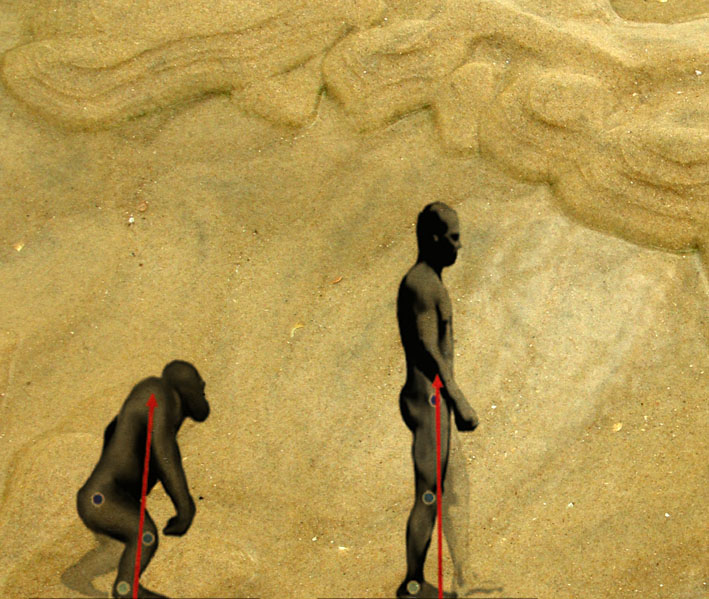
The great rift valleys of east Africa were and are dynamic places, tectonically and volcanically vigorous as the continent attempted to tear itself apart – and they were also our birthplace. A year ago I wrote about work on the footprints at Ileret, in northern Kenya, that told a small part of the story of our locomotive evolution; recently, there has been a further, fascinating, study reported on the classic footprints at Laetoli, just up the valley in Tanzania. The tracks from Laetoli are far older than those of Ileret, being (probably) Australopithecine prints dating 3.5-3.6 million years ago. Two, and possibly three individuals (one seems to have been walking in the footprints of another) tramped across wet volcanic ash spewed from the Sadiman volcano 20 kilometres away; the ash hardened and this fragment of their journey was preserved, to be discovered by Mary Leakey in 1976. Varied approaches to analysing these prints have been attempted, in the hope of shedding light on how these people (and yes, I feel quite comfortable using that term again) walked, but the recent work of David Raichlen and his colleagues at the University of Arizona at Tucson is particularly appealing. The entire paper is published in PloS One and summarised, for example, on Science News. The paper, titled “Laetoli Footprints Preserve Earliest Direct Evidence of Human-Like Bipedal Biomechanics,” begins:
Ever since Darwin, bipedal walking has been considered the defining feature of the human lineage. However, how and why this unique form of locomotion evolved remains the subject of considerable debate. In particular, debates over the origins and evolution of bipedalism revolve around whether early bipeds walked with energetically economical human-like extended limb biomechanics, or with more costly ape-like bent-knee, bent-hip (BKBH) kinematics. If early hominins used a BKBH gait, then we must account for the persistence of an energetically costly form of bipedal walking until the evolution of the genus Homo. The Laetoli footprints may help resolve this debate, since they record the footsteps of at least two, and possibly three individuals who walked bipedally across wet ashfall approximately 3.6 million years ago. These prints represent the earliest direct evidence of bipedalism in the fossil record, yet no study to date has demonstrated exactly how these hominins walked.
One of the many reasons that I find this work fascinating is (unsurprisingly) that the researchers used a carefully controlled bed of sand across which modern humans walked, normally and in an imitation of the “BKBH” gait, and sophisticated scanning of the results provided the key means of comparison with the Laetoli prints:
Here, we present the results of the first experimental analysis of footprints in a sample of humans walking with different gaits and compare our results to the Laetoli prints. Eight human subjects (mean body mass [SD] = 65.6 [6.1] kg) walked through a 5 m trackway filled with 15 cm of fine grained sand (0.075 mm–0.70 mm diameter). Although our subjects are likely heavier than the earlier hominins that generated the Laetoli prints, body mass does not appear to have an effect on footprint morphology. We compared footprints made by subjects walking with a normal, extended limb gait, and with a bent-knee, bent-hip (BKBH) ape-like gait at their preferred speeds with sand water content of 6–8% (see supplementary materials for hind limb kinematic data from these experiments). These substrate conditions match those of Laetoli, which are described as similar to damp, fine to medium grained sand . We also examined the effects of increased speed and increased substrate moisture (10–12% water) on footprint morphology. We tested the hypothesis that a BKBH gait alters body weight transfer and produces significantly different footprint morphology than an extended limb gait.
The results are summarised in the figure below, at the top a contour map and side view of the footprint of a modern human walking normally, below it a modern human doing the BKBH gait (which requires digging in the toes far more deeply), and, at the bottom, one of the Laetoli footprints: the comparisons are dramatic.
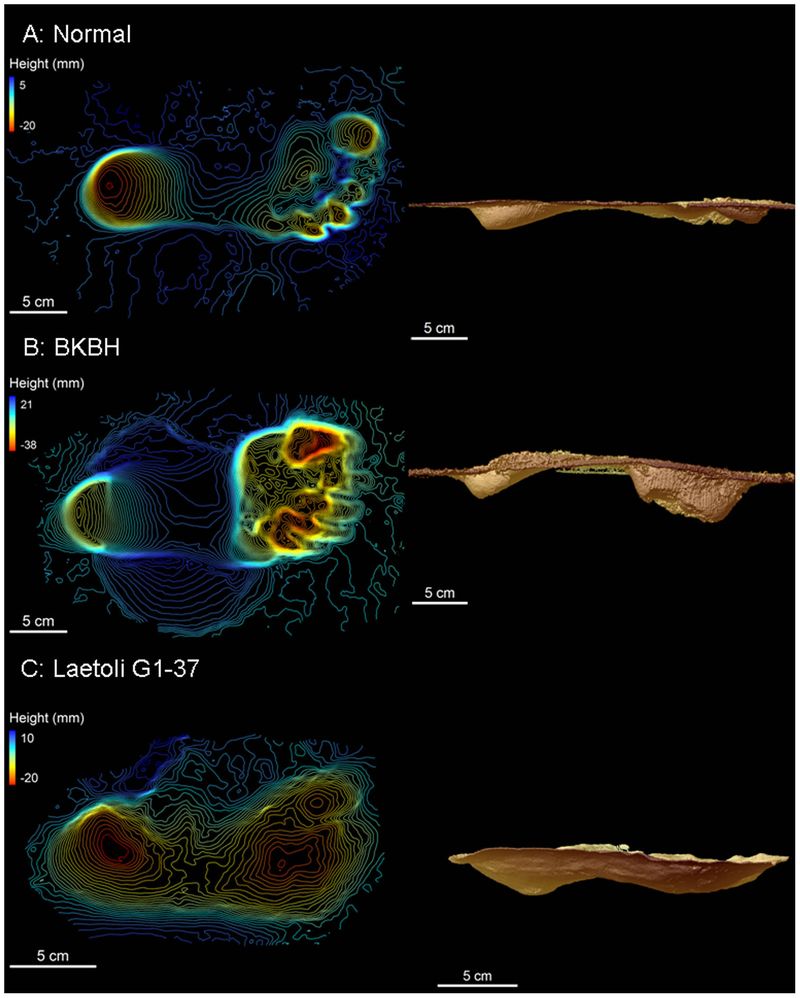
While it’s clear that these ancestors did not walk precisely as modern humans did, they certainly walked more like us than like apes:
These results provide us with the earliest direct evidence of kinematically human-like bipedalism currently known, and show that extended limb bipedalism evolved long before the appearance of the genus Homo. Since extended-limb bipedalism is more energetically economical than ape-like bipedalism, energy expenditure was likely an important selection pressure on hominin bipeds by 3.6 Ma.
Footprints in the sand – ancient and modern.
[gait illustration used in the image at the head of this post from “Chimpanzee locomotor energetics and the origin
of human bipedalism,” Michael D. Sockol, David A. Raichlen, and Herman Pontzer, available on PNAS]
Comments
that’s a great figure. thanks for the summary.
Footprints… theyve always been there. Nice work buddy, very interesting!