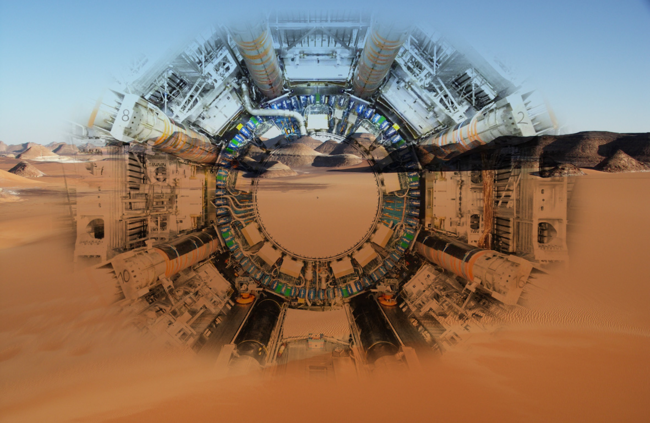
The possibilities surrounding the re-start of the Large Hadron Collider are endless, but what, of course, intrigued me in a recent piece in the New Scientist was the imagery of the desert. One of the aspirations for my book was to explore the many roles of the words “the desert” in our imaginations, and here they are as we continue our journey to unravel the secrets of life, the universe and all that.
The article begins:
THEY call it “the desert” – a vast, empty landscape separating us from a promised land that shimmers like a mirage on the horizon. A land full of answers, where we finally achieve a complete understanding of material reality.
Stop dreaming: we can’t get to this nirvana. The way across the desert is too long and hot, and we have no vehicle to take us there. But if physicists’ hopes are realised, a machine just waking from a two-year slumber could bring us a decisive step closer – and might even reveal answers closer to home…
Since February 2013, the LHC has been undergoing a comprehensive overhaul. Now it is gearing up again, more powerful than ever before, for a journey towards the desert – and the complete unknown. The excitement is palpable. “We are living in a once-in-a-lifetime experience, opening the curtains on a totally new energy scale,” says Jim Olsen of the LHC’s CMS experiment.
…
For most physicists, the conclusion is that the standard model is part of a bigger theory – one that brings us closer to unifying all forces and understanding matter at all energy scales. The problem is, although precise predictions vary, our best guess is that further bouts of force unification only lie at scales of trillions of TeV and above, that were last attained in the first trice of the universe – within 10-36 seconds of the big bang.
No accelerator on Earth could conceivably achieve such energies. In this picture, what lies between us and the unattainable promised land is a desert devoid of interest. It makes the LHC’s upgraded collision energy of 13 TeV seem a rather forlorn gesture.
Not so, says theorist Ben Allanach of the University of Cambridge. If the favourite candidate for a next-generation theory is right, the sliver of new territory we are about to enter could contain particles and phenomena that will take us a decisive step closer to an ultimate answer.
The theory in question is supersymmetry, or SUSY to its friends.
… gravity’s true strength might be such that the promised land of unification lies at energies much closer to where we are now, perhaps even within the LHC’s reach. Then the desert would be no desert, but full of a host of strange objects such as miniature black holes, which the LHC might be able to squeeze into existence by warping and pinching space-time in its collisions.
…
So the hope is that the territory about to be explored is a lush forest bristling with particles that give us clues to the nature of the desert – and beyond.
Comments
After nine days I let the horse run free
'Cause the desert had turned to sea
There were plants and birds and rocks and things
There was sand and hills and rings
The ocean is a desert with its life underground
And a perfect disguise above
Under the cities lies a heart made of ground
But the humans will give no love
You see I’ve been through the desert on a horse with no name
It felt good to be out of the rain
In the desert you can remember your name
'Cause there ain’t no one for to give you no pain
La, la …
Good luck to them.
/ miniature black holes, which the LHC might be able to squeeze into existence / While cool, do they have any idea of the consequences? Do they care? Man does way too much with too little knowledge and, as the saying goes, *Play with fire, get burned." They are simply playing. Blind boys tinkering.