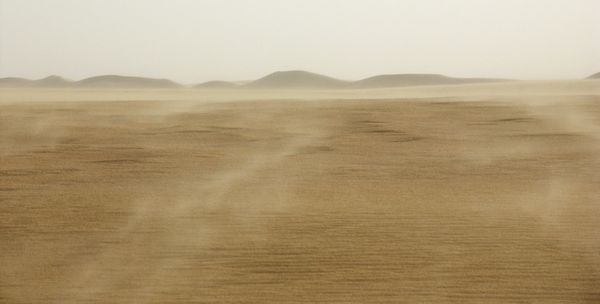
It begins with a dance. The wind playing games with the sand and the sand playing along. Ephemeral flurries, a shape-shifting fabric of turbulence, scurrying grains. It’s a compelling and alluring show, but, at the same time, as the wind gathers, the air begins to become oppressive and the brilliant blue sky takes on a threatening dullness as the cargo of dust changes the spectrum. The ephemeral flurries become continuous sheets of sand hurtling across the desert surface, assailing everything in their path. The sun is dimmed.
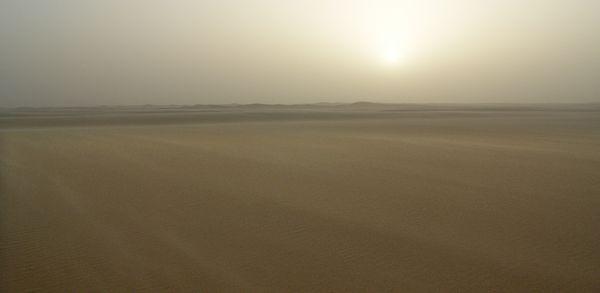
And then suddenly, seemingly out of nowhere, this streaming chaos turns into the full fury of a sandstorm, a full-blown assault, threatening everything.
Ahmed Hassanein Bey was a highly educated Egyptian, a diplomat and tutor to the king, but a man with deep Bedouin roots. He was the first to cross the Libyan Desert, from the Mediterranean to Sudan in a perilous eight-month journey by camel in 1923; in his extraordinary account of this journey, The Lost Oases, he describes the frequent sandstorms encountered:
It seems as the whole surface of the desert were rising in obedience to some upthrusting force from beneath. Larger pebbles strike against the shins, the knees, the thighs. The spray of dancing sand grains climbs the body till it strikes the face and goes over the head. The sky is shut out, all but the nearest camels fade from view, the universe is filled with hurtling, pelting, stinging, biting legions of torment…It is as though some great monster of fabled size and unearthly power were puffing out these hurtling blasts of sand upon the traveller’s head. The sound is that of a giant hand drawing rough fingers in regular rhythm across tightly stretched silk.
When a sandstorm comes, there is nothing to do but to push doggedly on. Around any stationary object, whether it might be a post, a camel or a man, the eager sands swiftly gather, piling up and up until there remains only a smoothly rounded heap. If it is torture to go on, it is death itself to halt.
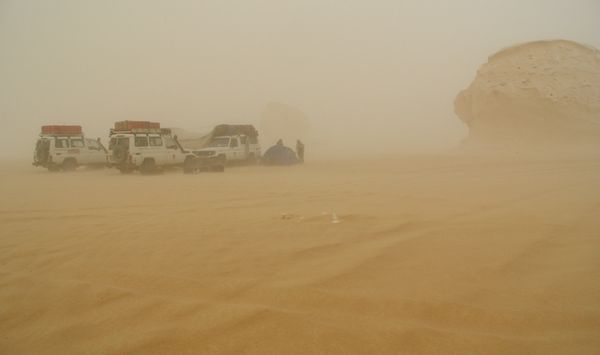
During my expedition to the Western - or Libyan – Desert a few years ago, we were assailed by two full-blown sandstorms, the second one far worse than the first. In this age of motor travel, stopping is, unlike in the days of camel transport, the only option, unless frosted windscreens and severe testing of the seals of mechanical components are wished for. The system, well-practised by our drivers and guides, is to circle the wagons – form the vehicles into a square and lash large pieces of heavy fabric between them in an attempt to provide shelter. The attempt can only be partially successful - Hassanein Bey again:
The storm drives the sand into everything one possesses. It fills clothes, food, baggage, instruments, everything. It searches out every weak spot in one’s armour. One feels it, breathes it, eats it, drinks it – and hates it. The finest particles even penetrate the pores of the skin, setting up a distressing irritation.
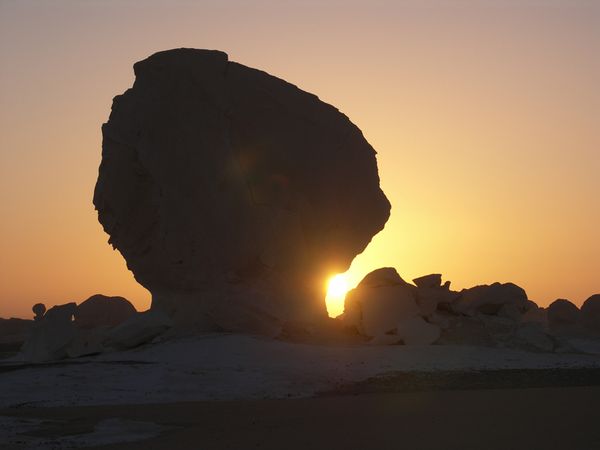
Our real humdinger of a sandstorm, one that our guides ranked among the worst they had experienced, was in the White Desert, an iconic and spectacular landscape of white limestone sculptures, created by the wind with sand as its tool.
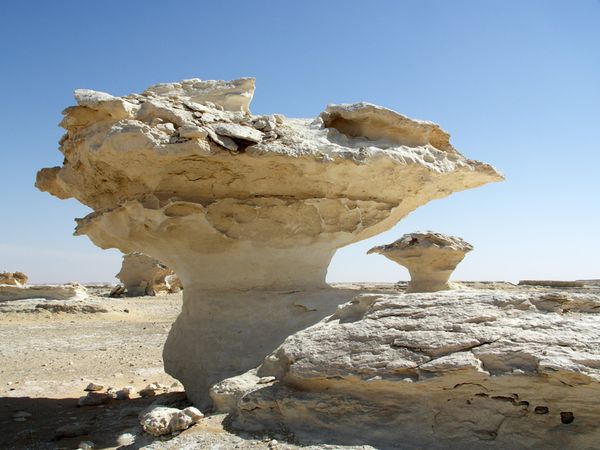
The wind had been gathering all afternoon, the air becoming oppressive, and the sky increasingly dull. As the storm gathered, I had stupidly attempted to put up a tent, but had to give up with the job only half-done. Determined to make the most of the experience, I huddled into the doorway of the semi-erected tent, wrapped a long piece of blue-dyed Moroccan cotton fabric around my head and face in an amateurish imitation of a Tuareg, and took out my notebook. The earth was on the move. As miniature sand dunes migrated past, and the hissing, spattering sound of the grains grew in volume, the burial process began. Piles of sand accumulated rapidly against my legs and began to weigh down the defenceless side of the tent. I tried to scribble down my account, but even a pencil had problems and sand accumulated in the hinge of my notebook (grains still fall out when I open it today). I watched some of my companions trying to put up their tent, and the drivers scrabbling to get some kind of shelter lashed down between the Landcruisers. There were no camels by which to judge visibility, but only during the occasional brief lull in the onslaught could this nearby scene be discerned with any clarity.
It was during one of these brief moments that, perhaps driven to dementia by the granular onslaught, I completely lost control of my senses and took out my camera.
There were two results of doing this – one photograph, and, ever after, a scratching sound when adjusting the telephoto lens.
I gave up, and battled my way to the shelter where my companions huddled, sharing the now very limited supplies of single malt whisky. Somehow, amazingly, in this mayhem, the cooks produced food; sleep that night was intermittent, but I remember being awakened at one point because the noise had stopped. And dawn was miraculous. There was no sign of the storm (other than the piles of sand marking buried tents), but rather a crystalline clarity, a sense that the desert had been cleansed.
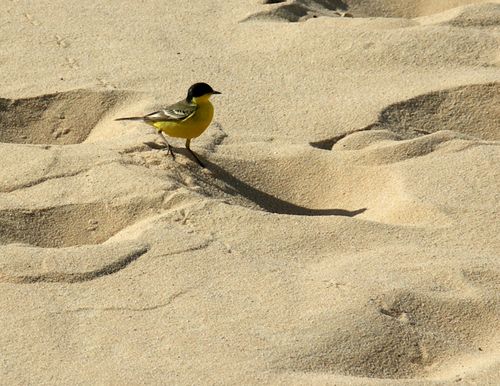
And, suddenly, there was this colourful and fearless little bird strutting about in the sand – where could it possibly have sheltered overnight during the storm?
This was a staggeringly beautiful landscape, but one completely different from the previous day: immeasurable, unimaginable, volumes of the earth’s fabric had been moved, wholesale, from one place to another.
[This is my contribution to The Accretionary Wedge, December 2012, hosted by Ron Schott, with the theme “The Most Memorable Geological Event That You’ve Directly Experienced.”]
Comments
Lovely description of a short-lived sandstorm. I’ve read of sandstorms in the Negev and coastal Red Sea environs, that last for days-to-a-week (Harmattan winds, typically in March). The locals stoically shut-down all activity and wait it out. One has not choice, really.
Interestingly, here in the interior PNW, our loess soils have reportedly caused dust-storms visible 400 miles out to sea, in past decades (pre-soil conservation measures). Astounding.
Thanks for the comment - yes, this one was relatively short-lived, but long enough!
Pacific Northwest dust storms continue today - there’s a spectacular image from 2009 at http://earthobservatory.nasa.gov/NaturalHazards/view.php?id=40590