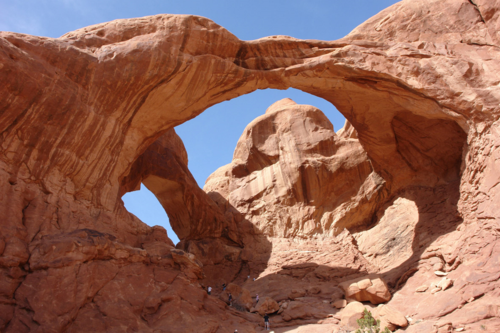
In his classic and wonderful book Desert Solitaire, the original eco-warrior, Edward Abbey, described the landscapes of Utah’s Arches National Monument:
… here all is exposed and naked, dominated by the monolithic formations of sandstone which stand above the ground and extend for miles, sometimes level, sometimes tilted or warped by pressures from below, carved by erosion and weathering into an intricate maze of glens, grottoes, fissures, passageways, and deep narrow canyons.
At first look it all seems like a geologic chaos, but there is a method at work here, method of a fanatic order and perseverance…
But exactly what the method actually was that sculpted the arches and other bizarre examples of natural land art has long been a topic of debate. Native Americans saw their origins in the work of the Great Sky Father, early settlers thought they were prehistoric native carvings, and conventional wisdom has ascribed these landforms in a general way to the erosional work of wind, water and salt. Fine, but why arches? Clearly, anisotropy within the body of the sandstone must be part of the equation, perhaps related to fractures and differential stress distribution; an interesting paper along these lines was published in the Geological Society of America Bulletin twenty years ago, and the pre-publication version is freely available online.
Just last month, a fascinating piece of work titled “Sandstone landforms shaped by negative feedback between stress and erosion” was published in Nature Geoscience and described clearly in an article from The Smithsonian. Jiri Bruthans and his colleagues in Prague use a series of physical experiments (see the fascinating video on the Smithsonian site), mathematical modelling and ‘ground-truthing’ to demonstrate that the gravitational load on a pile of sandstone can cause a differential stress distribution within the rock and the consequent ‘locking’ of sand particles along trajectories that, as a result, are stronger and more resistant to weathering and erosion. Furthermore, once the looser grains are removed the remaining locked volumes become even stronger, hence the feedback component. By introducing imperfections in the sandstone (small cuts, fractures and so on) they can reproduce an impressive variety of exotic landforms – including arches:
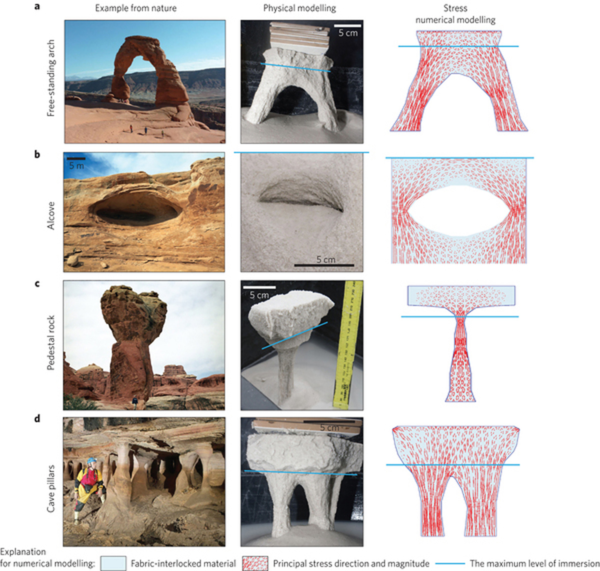
(illustration from the Nature Geoscience paper)
This is intriguing in itself, but what I couldn’t help wondering is that surely there must be a connection between this work and the strange world of granular physics. This is an inexhaustible topic that first fascinated me as I was researching the Sand book and has had me in its grip ever since. Explaining the behaviours of the ‘simple’ material, sand – dry, wet, damp – poses challenges to cutting-edge physics and engineering research worldwide. Among these strange behaviours is jamming, the sudden locking up of otherwise free-flowing grains. The (apparently) simplest example is sand, or any other granular material, flowing through a funnel: periodically, unpredictably, and frustratingly the grains will lock and the flow stops. A critical part of the design of a sandglass is the size and shape of the aperture in relation to the sizes and shapes of the sand grains – continuous flow without jamming has to be guaranteed. And then, among the myriad challenges presented by the requirements of handling industrial granular materials, is the flow of grain from a silo through a hopper – something that turns out not to be at all simple.
Silos of grain occasionally, and without warning, explode, despite design specifications that theoretically far exceed the stresses of the contained material (a tragedy when, as has happened in Scotland, the grain should have been used in the production of single malt whisky). Research to explain such events has demonstrated that the distribution of stress within a pile of grains is far from uniform, that particularly high stress is carried along very specific trajectories – ‘force chains’ – within the pile and those forces can spontaneously structure themselves to act against the walls of the container: the silo collapses.
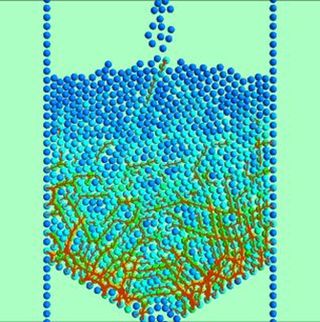 The ever-shifting and re-forming force chains that are typical of granular flow through a hopper have been cleverly modelled. The illustration at left is by Dennis C Rapaport of the Department of Physics at Bar-Ilan University in Tel Aviv and the animation can be seen on his website. And here from a YouTube video by George Lesica:

In both, the shape-shifting force chains can be clearly seen, and it is these that, if they happen to organise themselves properly, contribute to the material jamming. Junyao Tang and Bob Behringer of the physics department at Duke University have made a compelling video of this happening:
So, differential stresses, force chains and jamming in granular materials seem to me to be intimately related to the work published in Nature Geoscience, and the sculpting of bizarre landforms. For these phenomena are not restricted to flowing granular materials, but occur in sand piles – I find this illustration from the work of Radoslaw Michalowski at the University of Michigan intriguing:
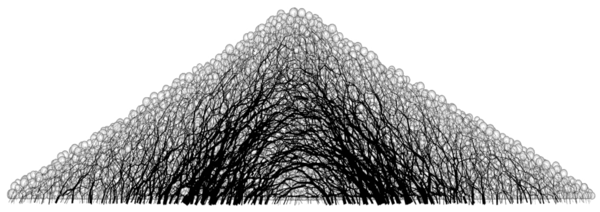
Michalowski’s project is titled “Arching in Soils” and he describes the illustration thus (my emphasis):
While the term arching has been accepted in the geotechnical literature, the concept does not relate to a formation of a physical arch (as seen in karst formations), but rather a re-distribution of stress (or variation in the stress field), where stiffer components of the system attract more loads. The description is still elusive, and research toward prediction of arching is carried out. Arching in a model of a sand heap is illustrated in the figure, producing a stress ‘dip’ at the center of the base… While the appearance of the stress dip may be a curiosity problem, arching associated with it is a phenomenon of interest and importance in geotechnical engineering.
Ring any bells, this fanatic order?
[Image at the head of this post “Double arch” by Hustvedt - Own work. Licensed under Creative Commons Attribution-Share Alike 3.0 via Wikimedia Commons. For an excellent introductory video of some of the wonders and challenges of granular materials I suggest this from the National Science Foundation.]
Comments
Waves. Pressure waves, everywhere, on logarithmic scales of size over many orders of magnitude. Waves reshaping their media; the properties of media reshaping waves. Waves running through each other; waves impinging and locking together as temporary if long-lasting rigidities, geomorphic or chemical: electron waves the properties of materials. Rigidities, metastable equilibria, and stress field variations deflecting waves. Panta rhei, everything flows, at various rates, on logarithmic scales of time over many orders of magnitude.
One bell it rings (and it all rings, panta seii(?) my Greek’s not up to this, but the root is the same as for seism) – is Solaris. Slower, though, and deeper. Many thanks for drawing together this range of perceptions.
Oh, and the Nature Geoscience diagrams of stress numerical modeling look very much like the physical models used to show stress in building arches, columns, entablatures, etc.–nature imitating art, as Wilde did not quite say.
“Panta rhei” reminded me of the news from earlier this year that “the world’s longest-running experiment” had recorded the fall of another drop of pitch (see http://www.newscientist.com/article/dn25441-longest-experiment-sees-pitch-drop-after-84year-wait.html#.VAWJc_ldVn8).
And “waves running through each other” reminded me of the mysteries of barchan dunes merging and emerging.
Then there are physical models of stress in architecture - see Gaudi’s catenary models for the Sagrad Familia…
It’s all too fascinating - thanks, Richard!