Sediments around the planet continue their activities, paying no respect to our definitions of time or discipline. What we see today along our coasts is but an instantaneous legacy of yesterday and the prelude for tomorrow. Despite this natural continuity, there has long been something of a gap between our self-imposed perspectives on geology and archaeology. Thankfully, rationally, and fascinatingly, this gap is now closing, and this is well illustrated by a feature article in the current issue of Geology Today. “Coastal and ancient harbour archaeology” is written by workers at the French Universities of Aix-Marseille and Lyon (see the reference below), and it makes for stimulating reading. The abstract is as follows:
What roles have human impacts and natural processes had in shaping the evolution of Mediterranean coastlines during the Holocene? Where, when and how did societies transform the coastal zone? At what scales and rhythms did these changes take place? What can ancient harbour sediments tell us about human-environment interactions? During the past 20 years, geoarchaeological research in the Mediterranean has attempted to understand the interplay between culture and nature, and more particularly how environments and processes have played a role in Holocene human occupation of the coastal zone. This approach has drawn on the multidisciplinary study of sediments, as archives of information, to attempt to differentiate between anthropogenic and natural factors, the latter, we argue, having played an increasingly secondary role with time. Three important spatial scales of analysis have emerged, local, regional and Mediterranean, all of which are outlined here.
The Mediterranean is one of the “cradles of civilisation” and, being a geologically dynamic region, the interplay between history, culture, and geology is deep and complex. As the ice receded and sea levels rose after the end of the last glaciation, valleys were inundated, estuaries formed, and a ruggedly shaped coastline resulted. But then, around 6,000 years ago, as the rate of sea level rise diminished, erosion and sediment supply took over. Estuaries filled in, river deltas built out, and complexes of lagoons and sand bars came to dominate much of the extending (prograding) coasts. This was an ideal setting for a cradle of civilisation, forming the arena for cultural development from the Bronze Age, 5,000 years or so ago, to the present day. Settlement and trade required harbours, many of which could be developed from natural features, some of which were the sites of innovative and monumental construction. Some of these harbours survive to the present day, many suffered destruction at the hands of man, or, more commonly, nature. The sedimentary record in these ancient harbours tells these stories.
As the article states,
…the study of sedimentary archives has grown into a flourishing branch of archaeological enquiry. It has effectively been demonstrated that ancient harbours constitute outstanding archives of both the cultural and environmental pasts. Their sediments are particularly rich in research objects bioindicators, macrorests [plant and pollen remains], artefacts, etc.), a multiplicity that accrues not only insights into the history of human occupation at a given site, but also into the mobility of its coastlines, in addition to the natural processes and hazards having impacted these waterfront areas.
The Mediterranean is littered with examples of harbours abandoned as a result of being filled with sand and silt, in turn a consequence of their disruption of natural sediment budgets (of course, we haven’t learned much - manipulation and busting of these budgets remains a critical coastal problem today around the world). The Geology Today article refers to work in Cyprus where the growth of a river delta over the last 5,000 years caused the relocation of a harbour four times - twice during the Bronze Age, once in Graeco-Roman times and once during the Mediaeval period.
Natural processes exploit our attempts to exploit them, and this is dramatically the case with harbours built entirely artificially - in places where no natural facility is available. As the authors of the article remark, “In effect, the overriding problem posed by artificially protected harbours was the impact of acute sediment accumulation.” The great Phoenician city of Tyre, in today’s Lebanon, was developed around a small island just offshore, with two harbours to the north and south. In 332 BC, Alexander the Great conquered the city and built a causeway between the island and the mainland; this profoundly disrupted sediment budgets, causing the coastal sands to build out and eventually themselves permanently join the island to the mainland. The harbours were ruined. The Geology Today article uses work on the geoarchaeology of Tyre to illustrate just how informative this approach can be. The illustration below is from the article. It shows the details of 9 metre core taken in the old harbour sediments that today lie below the city centre. Naturally, the oldest sediments are at the bottom and date from more than 8,000 years ago - sea level was still rising. By around 6,000 years ago, coarse beach sands were deposited, foolwed by fine sands as the harbour construction took place. The youngest sands are coarse-grained, the environment reverting to coastal beaches as the port was “semi-abandoned.”
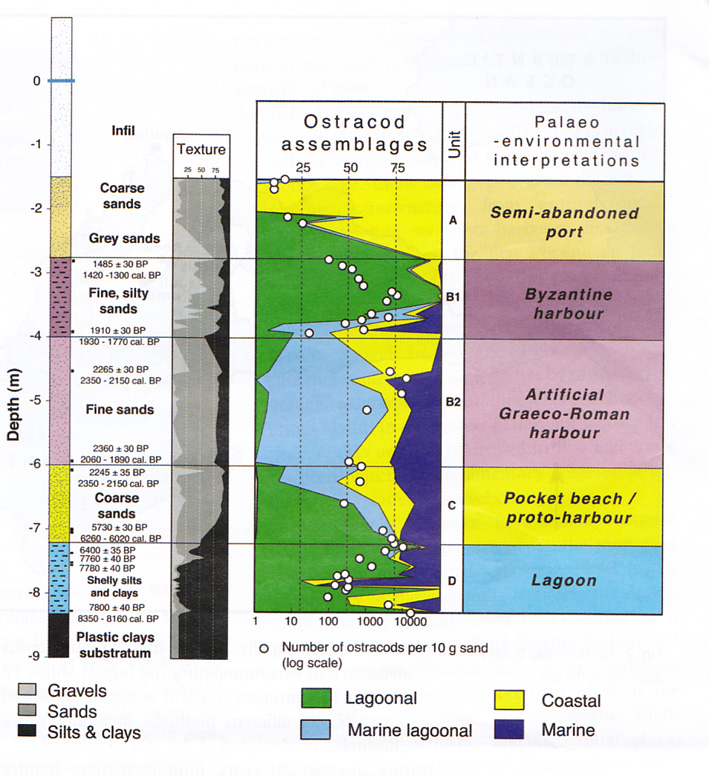
The “ostracod assemblages” illustrated are extremely helpful in terms both of dating and as environmental indicators. Ostracods are microscopic crustacea, and the circles on the diagram show their frequency of occurrence (the log scale at the bottom) and the colours show the proportions of ostracods from different environments as they vary with time and position in the core. The period of the port’s heyday is characterised by “marine lagoonal” ostracods - quiet waters but marine, as you would expect in a protected harbour.
I followed up on one of the references in the paper, work by a group of researchers at McMaster University in Canada, in collaboration with the the University of Haifa (see reference below). The title of the paper intrigued me: “The tsunami of 13 December A.D. 115 and the destruction of Herod the Great’s harbor at Caesarea Maritima, Israel.” Caesarea Maritima was a great city and Harbour built by Herod the Great, starting around 25 BC. The image below (from the useful site describing work by the University of Victoria shows what now remains of the gigantic construction, together with, below the waves, the outlines of its original extent.
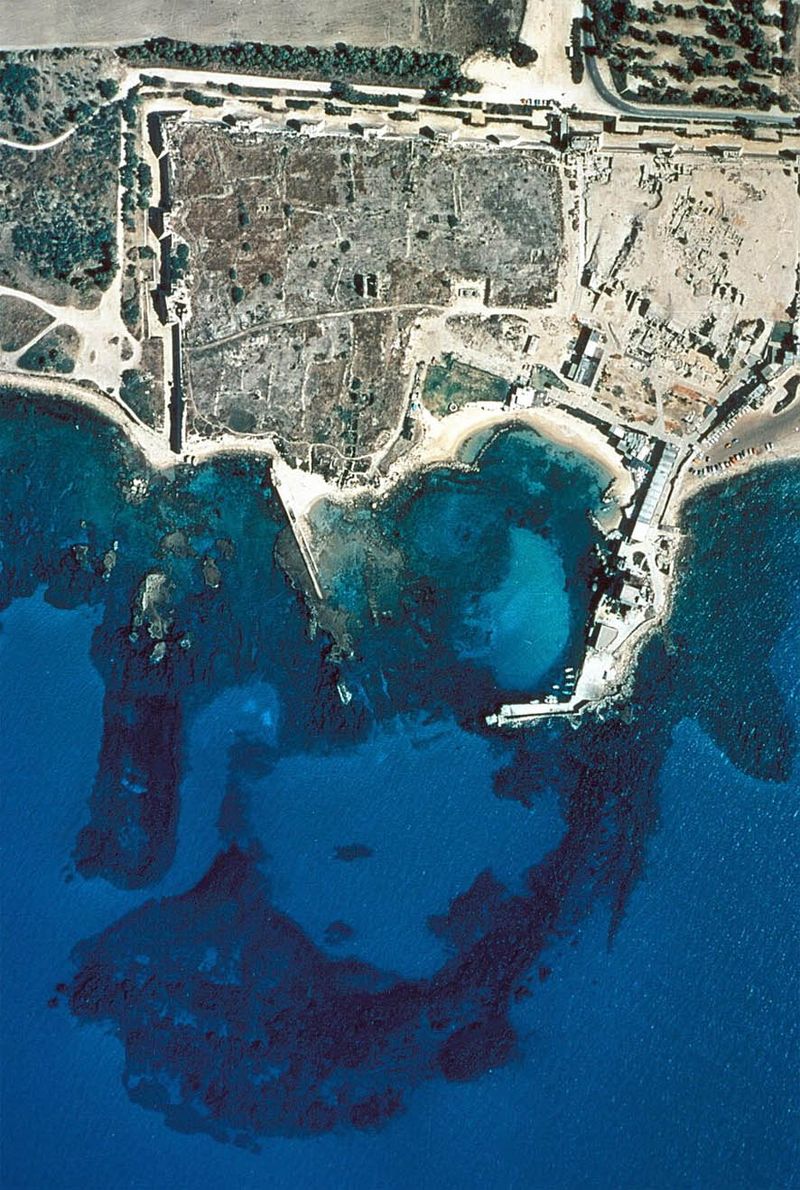
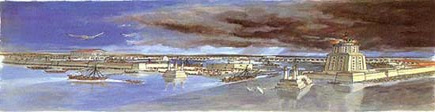
This was an extravagant construction for an extravagant city; it was the largest artificial harbour ever built at that point, and used Roman engineering - the basis of the construction was a series of caissons, made from concrete (ah yes, Roman concrete, Italian volcanic ash - another blog post…) and sunk to the sea bed. The painting at the top of this post (from the National Geographic and this site from Cornell University) shows what the port may have looked like in its glory days. But its glory days were not to last; Talmudic sources record a tsunami on the 13th December A.D. 115 that struck Caesarea, following an earhtquake that destroyed Antioch and probably originated in the subduction zone of the Cyprian arc to the west.
The paper describes underwater geoarchaeological investigations in the old harbour of Caesarea Maritima that have shown dramatic evidence in the sediments that support the idea that the port was destroyed by a tsunami. Excavating trenches revealed older sands scoured and eroded by an extraordinary overlying deposit of shells and shell fragments, pebbles, coarse sand, and pottery; the layer shows reverse-grading - the coarsest fragments at the top, typical of deposition from the sudden cessation of a high energy flow. The top of the layer is filled with clam shells deposited convex-side upwards - again a hydrodynamic indication of strong one-way flow. The authors argue - very convincingly - that this is a tsunami deposit, and the dating that has been possible is consistent with the A.D. 115 event. They included an illustration of the sequence of events:
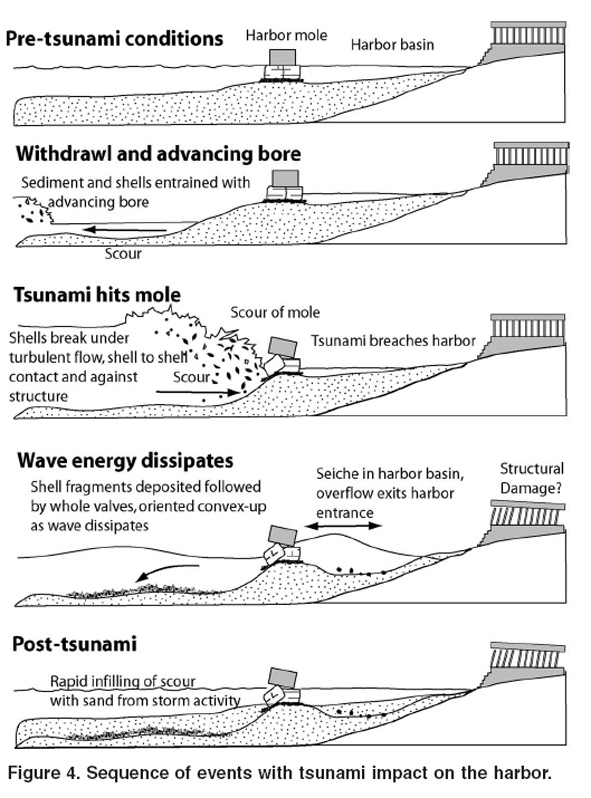
The tsunami deposit is followed by a layer of sand filling in the sea bed after the disaster, and then the port clearly came back into use for a while, leaving behind a deposit of ship ballast and pottery overlain, in turn by a millennium or so of storm sands.
I wrote a post last year on tsunami sand forensics - it’s fascinating to see the application to dramatic events in the tumultuous history of the Mediterranean, and to see geology and archaeology collaborating.
[The following is the reference for the Geology Today article:
Coastal and ancient harbour geoarchaeology
N. Marriner 1 , C. Morhange 1 & J.P. Goiran 2
1 CNRS CEREGE UMR 6635, Université Aix-Marseille, Europôle de l’Arbois, BP 80, 13545 Aix-en-Provence Cedex 04, France. marriner@cerege.fr 2 CNRS MOM Archéorient UMR 5133, 5/7 rue Raulin, 69365 Lyon Cedex 07, France.
Volume 26 Issue 1, Pages 21 - 2
The Caesarea Maritima work is described in the following paper in Geology:
The tsunami of 13 December A.D. 115 and the destruction of Herod the Great’s harbor at Caesarea Maritima, Israel
Eduard G. Reinhardt, Beverly N. Goodman, Joe I. Boyce, Gloria Lopez, Peter van Hengstum, W. Jack Rink, Yossi Mart and Avner Raban
Geology 2006;34;1061-1064]
Comments
No comments yet.