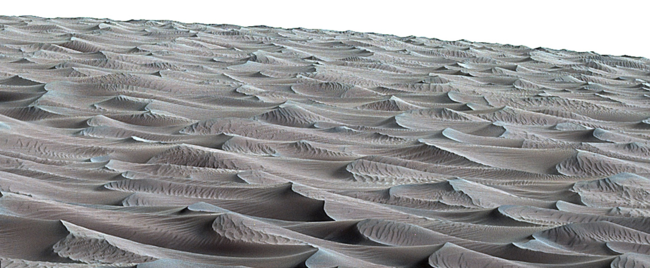
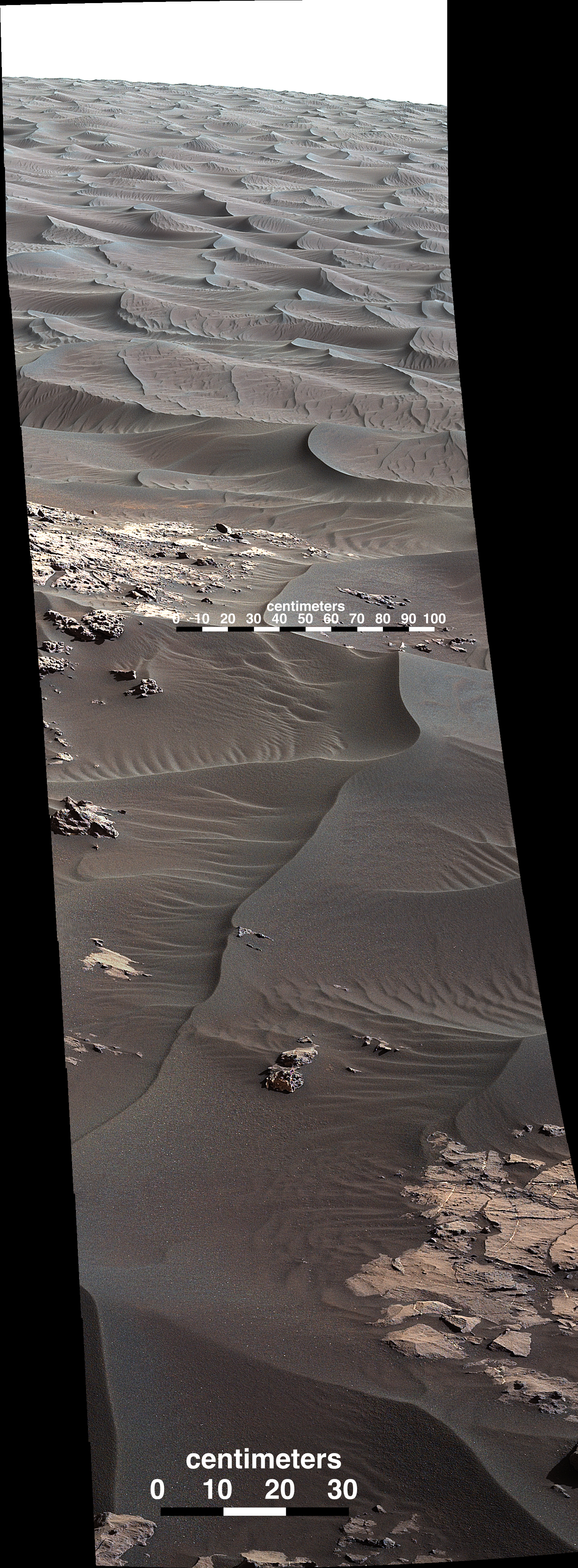
Last month, NASA issued a press release to announce that the Curiosity Rover had reached the “Bagnold dunes” and was preparing to investigate. The image above is from that announcement – the landscape covered is only a few meters across, but it is extraordinary and just seems, instinctively, to be unearthly. As Nathan Bridges of the Johns Hopkins University’s Applied Physics Laboratory, Laurel, Maryland, and leader of the Curiosity team’s planning for the dune campaign remarked in an earlier discussion of the project:
These dunes have a different texture from dunes on Earth. The ripples on them are much larger than ripples on top of dunes on Earth, and we don’t know why. We have models based on the lower air pressure. It takes a higher wind speed to get a particle moving. But now we’ll have the first opportunity to make detailed observations.
Indeed. The first detailed examination of extra-terrestrial sand dunes, to take place over the next few months, will be incredibly exciting, and it is only appropriate that those dunes are, if only informally, named after Ralph Bagnold. Readers of this blog and my books will have sensed that Bagnold is something of hero of mine, and I like to refer to him as “the man who figured out how deserts work.” One only wishes that he was still around and that we could hear his reactions to Curiosity, the images, the science and engineering. I am of the generation that still has difficulty not finding this whole project incredible, and I know that Bagnold would have been totally engrossed in the science, the technology – and the people.
In his frustratingly short (but fascinating) 1990 autobiography, Sand, Wind, and War, Bagnold cryptically titled Chapter 17, “Later: 1974-1986”. In it, he writes:
One memorable event in 1977 occurred when I was asked by the National Aeronautics and Space Administration (NASA) to give the keynote address at a meeting of geologists and other space scientists.The meeting was to compare the desert landscapes of Earth and Mars. It was held for a week at Palm Desert, a new, up-and-coming offshoot of Palm Springs in Southern California. The site of the meeting had been specially chosen for the desert character of its surroundings. However, during that week it rained every day. The main thoroughfare through town, labeled Bob Hope Street, was still only dirt. It was all but washed away.
NASA had recently sent spacecraft to orbit Mars and had succeeded in landing an unmanned craft to take close-up pictures. Those photos of the landscape revealed apparent sand dune forms much like those on Earth, in spite of the vastly different atmosphere. This had already started theories, but it was, and still is, mere guesswork as to what the stuff of the so-called dunes really is. We have no tangible evidence, and won’t have until some of it is brought back to Earth. Is it granular, like sand, or fluffy like snowflakes? And we still have but little idea of the scale of the dune heights…
I spent one evening at a McDonald’s with a small group of young scientists from NASA’s Jet Propulsion Laboratory in Pasadena. It was fascinating for an old man of eighty-one to listen to their casual talk of navigating a spacecraft two hundred million miles away as easily as an aeroplane. Man had not begun to fly at all when I was born.
The Bagnold Dunes lie in Gale crater, and are a stopping point for Curiosity on its journey up the slopes of Mount Sharp. The part of the dune field that the rover has arrived at is shown in this image – the dark band of rippled sand in front of Mount Sharp which looms intriguingly in the background.
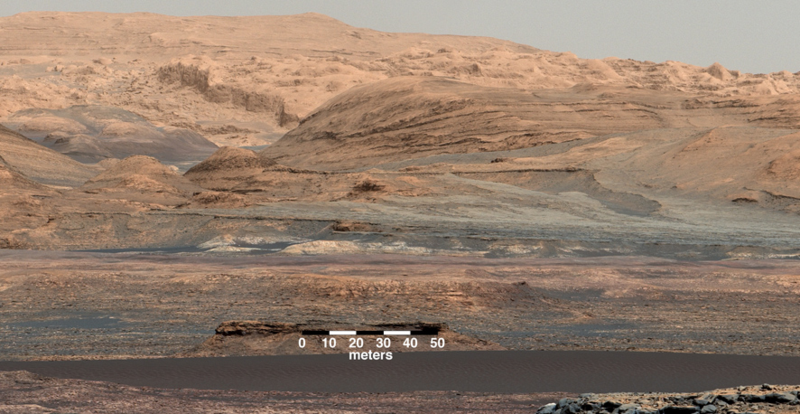
Bethany Ehlmann of the California Institute of Technology and NASA’s Jet Propulsion Laboratory is another member of the project team, and she introduces it in a great little video. As she comments, the dunes are dark because the sand grains are derived from basaltic rocks, and they cover the older, lighter-coloured, sandstones, some of which are themselves ancient dunes. Curiosity will be conducting fieldwork on what was originally called Dune 2, now the high dune, which is but a part of the much larger dune field. This beautiful image shows the dune, part of the larger dune field, and the journey of Curiosity to its current position:
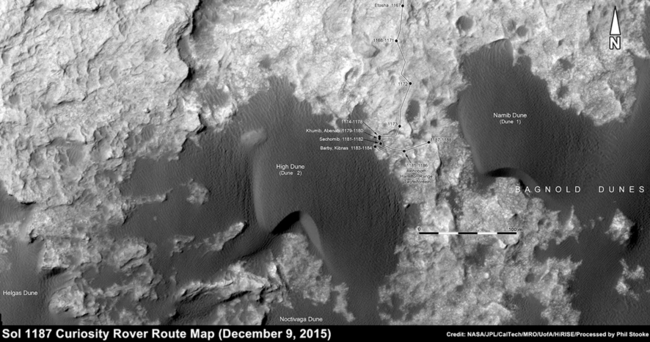
In the image at the head of this post, we are only looking at a small area of the whole dune, but from imagery over the years by NASA’s orbiting HiRISE camera, it is clear that the dune is active and on the move. As Bethany Ehlman describes, echoing Ralph Bagnold, in the reduced gravity, thin atmosphere, and unknown wind conditions on Mars, exactly how sand grains are transported and dunes migrate is still a mystery. But, thanks to Curiosity, perhaps not for long.
Ralph Bagnold became frustrated by the lack of desert wind data critical for developing his pioneering work on the physics of blown sand (he moved on to the physics of water-borne sediment). But Curiosity is already on the job, gathering the wind data that will help us understand how Martian sand moves. And the Rover has an extraordinary array of other instrumentation at the end of its long robotic arm, including a sand sampler and sieves that will tell the stories of grain size distributions that Bagnold determined were so informative.
At the end of Curiosity’s robotic arm is a suite of devices that enable Collection and Handling for In-situ Martian Rock Analysis, otherwise known as CHIMRA. This combination of geological tools, operated remotely hundreds of millions of miles away, is incredible:
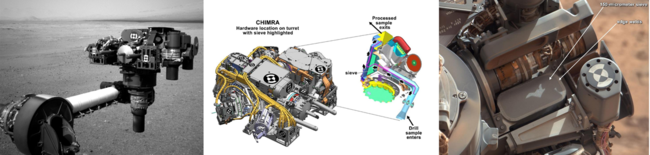
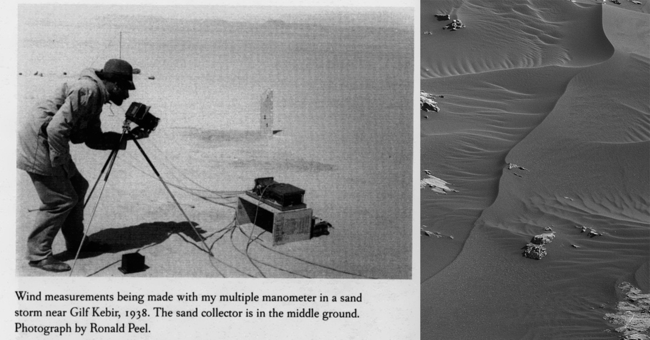
Ralph Bagnold was not only a scientist but also an engineer who designed, developed and built his own equipment, unique and exquisitely sophisticated. As we remember him working on field measurements in Egypt’s Western Desert in 1938, it doesn’t take much imagination to visualise him not only impressed with CHIMRA, but enthusiastically contributing to the project.
Comments
Du hast eine sehr informative Seite. Gratulation! Ich habe den Link in meinem Blog eingefügt. Grüße aus dem Gebirge. Ernestus.
Vielen Dank!
Ihre Sammlung und Bildersind sind wunderbar - Vielen Dank für die Blog-Link.
Michael
An intriguing post, Michael, thank you! Astroeremology is something I’ve had an armchair interest in for years.
On a separate-but-related subject (and at the risk of not just sounding like a crank, but actually being one), I’m curious if you’re familiar with the magnetic stripes the Mars Global Surveyor detected back in 1997. They’re similar – in appearance, at least – to the ones detected in the Earth’s crust that led to the discovery of sea floor spreading. Evidence that greatly strengthened the theory of plate tectonics. As I’m sure you’re well aware, the notion of any similar activity on Mars, even historically, is a controversial one. And given how long ago the Martian planetary dynamo shut down, the stripes out there probably do tell a different geologic story.
I mean, they might be hotspot artifacts (http://phys.org/news/2010-06-theory-magnetic-stripes-mars.html). Personally, though, I think at least some of them are magnetic paleodunes.
I realize that notion is complicated by a number of unanswered questions – e.g., Could highly magnetized ores be formed by eolian deposition? Even if they could, how might that happen in the absence of an atmospheric water cycle like Earth’s? Etc. Back when I first started nosing around astrogeology, I had an idea about this, based on the following (quite possibly bone-headed) assumptions:
1. Eolian deposition is routine on Mars.
2. Some sand dunes lithify.
3. Not all dunes that lithify need to do so in the context of precipitation.
4. Dunes that lithified in a post-precipitation Martian climate might do so if:
• The obliquity of Mars changed – as it is wont to do occasionally.
• As a result, the surface of the planet changed position relative to sun, exposing its massive CO2 ice fields in the southern polar region to increased temperatures, some of which melted.
• Enough CO2 was released to thicken the atmosphere slightly (creating a situation in which both wind patterns changed and small quantities of groundwater were not immediately sublimed away).
• Wind got shut off to particular dune field.
• Subsurface ice melted slightly, owing to elevated global temperatures.
• Moisture wicked up into the dune (because of the new temperature gradient), where it facilitated diagenesis.
But who knows, really? If they are paleodunes, they may have formed in the context of rain in some remote eon of Martian history. By counting the number of impact craters, measuring their size, and looking for evidence of previously observed erosion patterns, we should be able to “date” paleodune fields to known geochronological benchmarks, at the very least. If someone – or something – would take a closer look, all sorts of interesting, better-informed questions might be asked.
HiRISE may have helped sort this out already. But if so, I haven’t read about it. However we went about acquiring the topological data, whether using space-based remote sensing, or a single-use, LiDAR-enabled glider with an uplink to the MRO, or whatever, if we did find something consistent with dunes like those I’m hypothesizing, I’d love to see us drop a robot down to check them for magnetite, limonite, and other hematitic precipitate cements one would expect to see in a lithification process that involved extremely slow, very low T/P redox reactions – which would probably have reinforced the remnant magnetism in the hematite dust.
And, heck, if those magnetic lineations aren’t dunes, that’s probably even more interesting.
Anyhow, thank you again for the stimulating post, and for providing a forum in which to speculate about these mysteries while they remain unanswered. Have a good weekend!
Wayne - many thanks for this provocative comment and for your kind words (apologies for the delay in responding - I’ve been travelling).
These are intriguing ideas. Since it seems that conventional wisdom on Martian processes is regularly overturned, and since much of Martian atmospheric and fluid behaviour remains mysterious, your suggestions seem perfectly plausible. There’s certainly plenty of magnetite around on Mars and there would be no reason why windblown “placer” deposits shouldn’t be concentrated.
I do, however, have questions about scale. The rough dimensions of the Martian magnetic stripes are far greater than normal dunes or dune fields - and how much magnetite would have to be accumulated to create detectably signatures of this magnitude?
Oh, and thanks for “Astroeremology”!
wow beautiful the sand dunes especially the Bagnold dunes. how deep can they be from the ground
Images show the dunes piled up on top of the rcok surface - they typically reach a height of around 5 meters or somewhat more.
And, by the way, those “ripple” patterns are strange - see the latest NASA news release http://www.jpl.nasa.gov/news/news.php?feature=6551